Monday, April 6 Although scientists have studied how long Coronavirus lasts on surfaces, they didn't include fabrics, inexplicably, so we still don't know. All we can do is guess. Some hard surfaces like metal and glass it can last up to 5 days. Others like copper and aluminum 4 hours and 2-8 hours respectively. Copper is naturally antimicrobial although this property is still under research. Water in copper is much cleaner, without as much slime on the walls of the vessel, and this has been known since ancient times. E.coli dies after 1 or 2 hours on copper, whereas on stainless steel it lives for weeks, and MRSA dies within 2 hours also. With Influenza A, 75% of virus particles were reduced after one hour, and after 6 hours almost 100%.
Fingers, on the other hand, can transfer particles to up to 7 other clean surfaces once contaminated with virus particles. However, skin is still the most lethal thing to a virus. Generally the bacteria that lives on our skin kills viruses that land on it within 20 minutes unless there is an open wound which an opening for a viral infection. One reason to use band aids.
Coronavirus lasts on cardboard 24 hours, and polypropylene plastic 3 days. Why didn't they test latex, nitrile rubber, polyvinyl chloride and neoprene, which is what gloves are made from? Although cloth wasn't tested, it has been tested in the past for influenza. Generally viruses die in 4 hours or less on porous materials like clothes, toys, and wood. Actually there still remains virus material that can be detected with tests, but it's not generally viable as a critter that can infect cells. Porous surfaces suck moisture away from the virus causing the structures to collapse.
That said, up to 7 days still is the number for flu viruses being contagious on stainless steel, and 6 hours on copper.
The US government has stockpiled 29m doses of hydroxychloroquine, the synthetic form of quinine, reportedly. Trump's speech was quite serious about the virus, talking about staying indoors and not catching it, about people working on a vaccine.
Reportedly, ventilators are less useful than originally considered, since although they extend life, it's hard to get some patients off them afterwards, particularly it seems when they're older and have other health conditions.
The US's Dr. Fauci has said up to 50% of infections don't have symptoms. Ireland is saying 80% symptoms, 14% serious, and 6% critical.
Italy and Spain, with 13 and 15k deaths to date, are having lower numbers of deaths. In Europe, 20% or more people are over 65. In the UK, of the 403 deaths in the last 24 hours, they were aged 53 - 94, and only 15 had no known underlying health conditions, reportedly. Of the over 5000 who have died in the UK, they were aged 35 - 104.
UK PM moved to intensive care today, although it doesn't appear critical at this time.
It seems cats can be infected by people with Coronavirus.
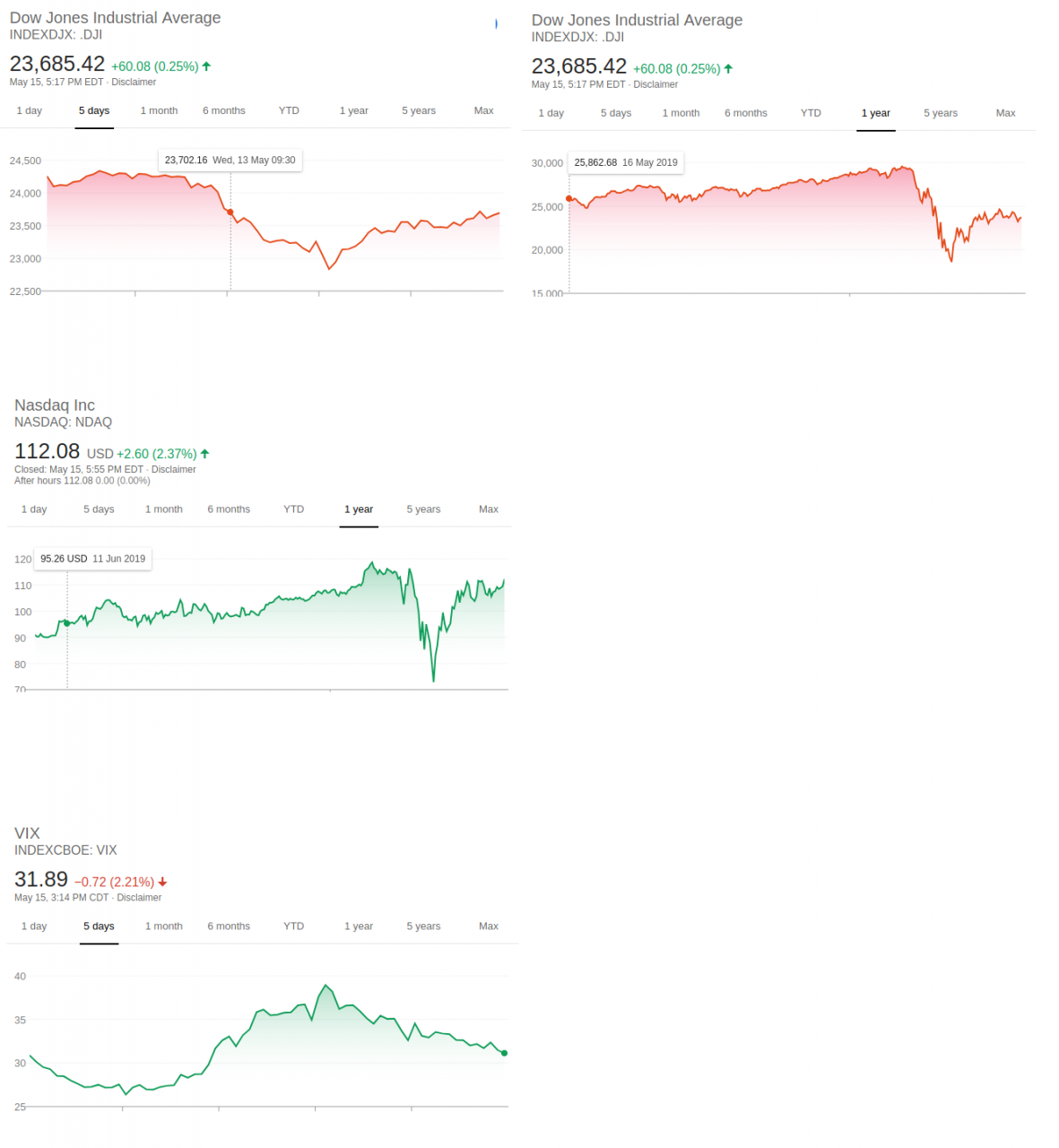
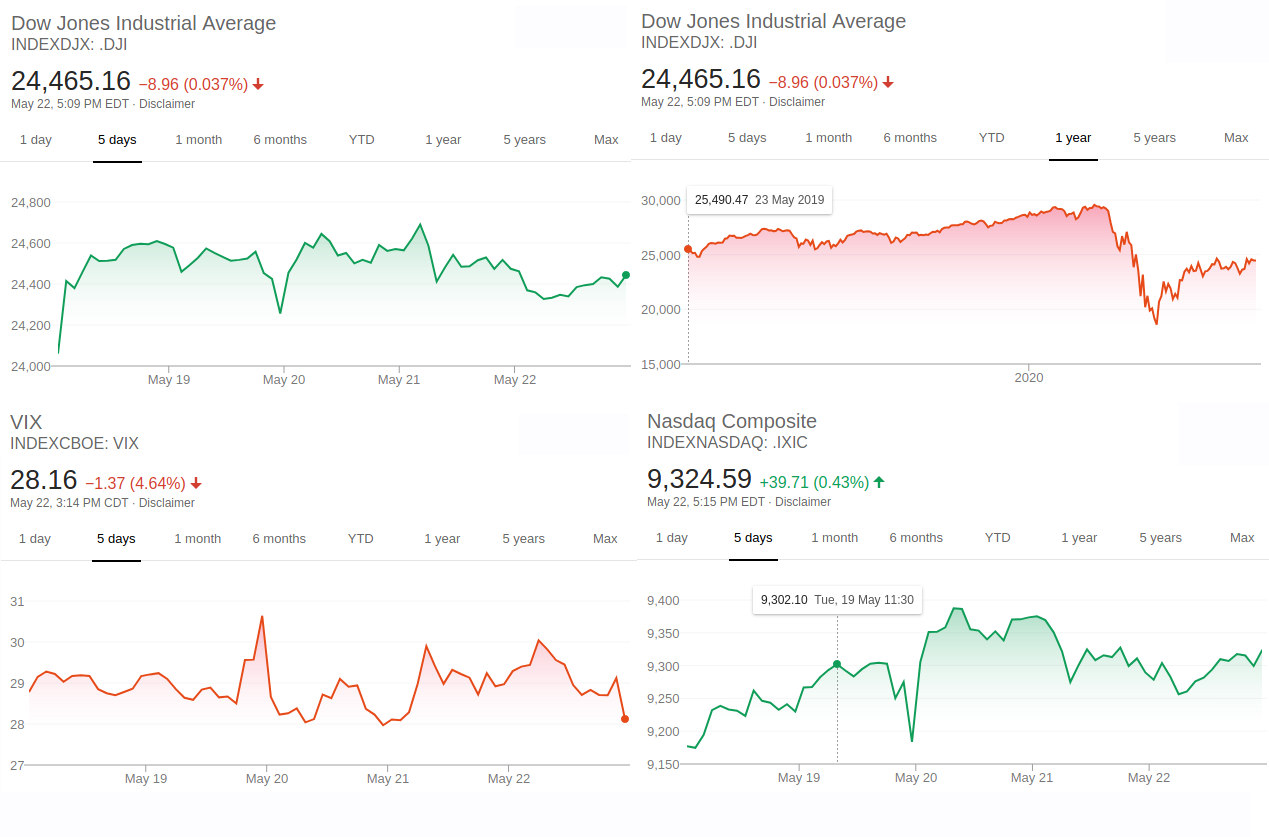
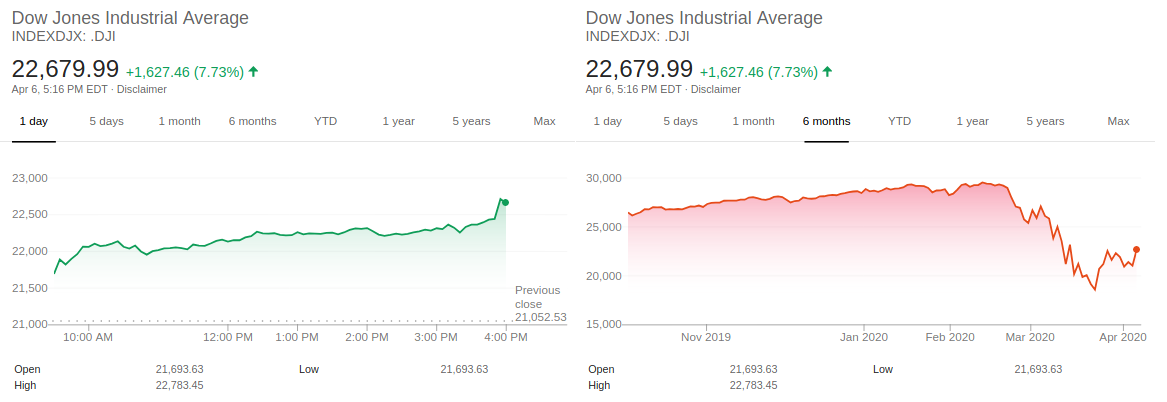
Although financial and economics news presenters and their expert guests have been saying we'll retest lows and expressing pessimism about the market, it has continued to go up. It went up another 8% today while the VIX went down 3%. The DOW is up to it's most recent high. Basically all stocks went up, including the virus-down stocks. Among the few stocks that went down were Zoom, Teledoc, and Ringcentral, stocks that went up because of the current situation. Gold up 2%. Brent down to $33 although oil stocks rose. Something like 80% of the best days happen in bear markets or the first 2 months after it, so investors advise not trying to time the bottom because you'll miss the best days.
The arguably top banker in the US Jamie Dimon in his letter today talked about a bad recession his bank wouldn't be immune to.
Banks keep getting downgraded, four times now, 40% now vs. pre-virus. Higher unemployment and lower interest rates, plus earnings down and credit loss.
However the market is emotional, there's a lot of money, and I think it's pretty common in participation, and it doesn't seem like people are feeling very depressed or pessimistic.
There's talk about a possible oil deal. Trump called SA and Russia and pulled a military card, reportedly, with future bases in SA, to put pressure on them. The possible deal is where SA and Russia first agree to go down 4m between the two from previous levels, not from new promised levels. And then take it to OPEC+ and Canada US Norway and Brazil would make up another 2m barrels in a possible deal.
SA's sovereign wealth fund bought 8% of Carnival stock, 44m shares for I guess around $450m. If Carnival pays anything like its recent 20% dividend, which it suspended last month, that stock which if it went to previous levels would be up hundreds of percent in value would provide decent returns.
Emerging markets are looking inexpensive right now, I guess partly because of the market volatility and also the currency devaluation in some places versus the US dollar.
Japan is going to declare a state of emergency tomorrow after an increase in cases.
In Colombia there have been a reported 46 deaths as we near the completion of 3 weeks under quarantine. Last week the new rule is you can only go out twice per week (depends on the last number in your ID card), and only one member of the family can go at a time. Downtown today there are more people out and about and hanging around than ever. I think some of this probably has to do with not caring or worrying, and another part with some people have no income or help, probably particularly Venezuelans.
Reportedly, some people in the US set up a fake testing center with tents and hazmat suits, costing a couple hundred dollars per test.
Friday, April 10 and the markets have been going up a percent or two every day. Economists have been saying we'll retest lows, based on historical records of not-really-but-could-be-similar recessions. The Fed keeps making actions and doing spending to keep the economy strong, and number have seemed to level off in some bad-hit countries in Europe. No one knows what the stock market is doing, because they've been wrong. I suspect it's a great time for algorithms because there's lots of volatility and the trend hasn't been terrible. The question remains whether there will be a recession, and there are a lot of people out of work, and if there was ever going to be a recession that the Fed wouldn't assist in.
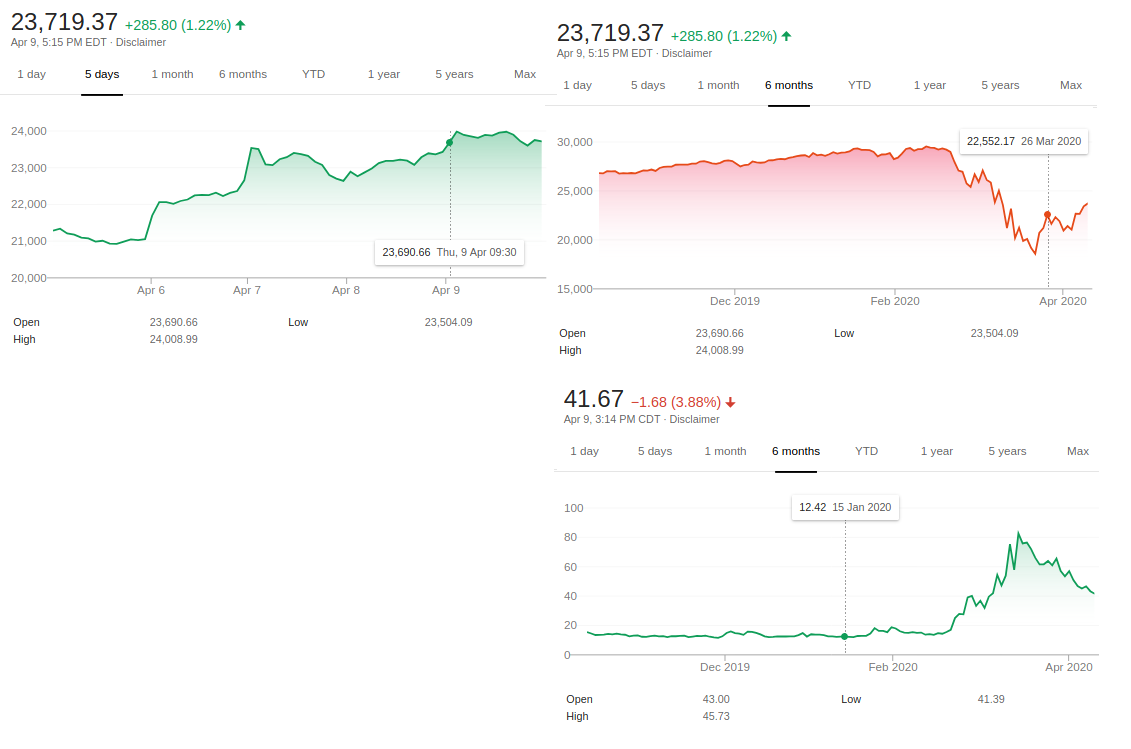
The Fed is basically buying every kind of debt to support every type of business short of equities. And if something else pops up they'll probably support that too.
The market now seems to have set a high and low point perhaps, where there's resistance on both sides. I wonder if past bear markets with rallies have been a slow realization of other factors. For example, we've been getting lots of news, both bad and good for the economy and for people, but the duration has been pretty short, and as time goes and economic factors start to slowly and grindingly pop up if that happens, people might be less optimistic. However the stock market is a price based on a few years ahead, and keeps getting further ahead it seems, and the multiple valuation seems to be possibly getting a higher multiple as well, perhaps just as a product of there being so much loose cash to invest. Economists might think about whether a recession or similar event helps remove a lot of cash wealth, or perhaps having lots of cash wealth is good. Still today, some economists and stock experts are saying there's signs there'll be a fast recovery, and others are saying there'll be a slow recovery.
The capital city here the mayor passed a law men and women are to be out on alternating days. The numbers of confirmed cases accumulate by a hundred or two per day, so we might have a thousand or two new infections per day. Does this mean people are not behaving in accordance with the quarantine? or is that numbers that happen when people do behave in quarantine? Here in the second biggest city they had already instituted the system where you can shop for groceries on the 2 days per week based on the last number of your ID card.
There are now over 100,000 deaths from Coronavirus known worldwide.
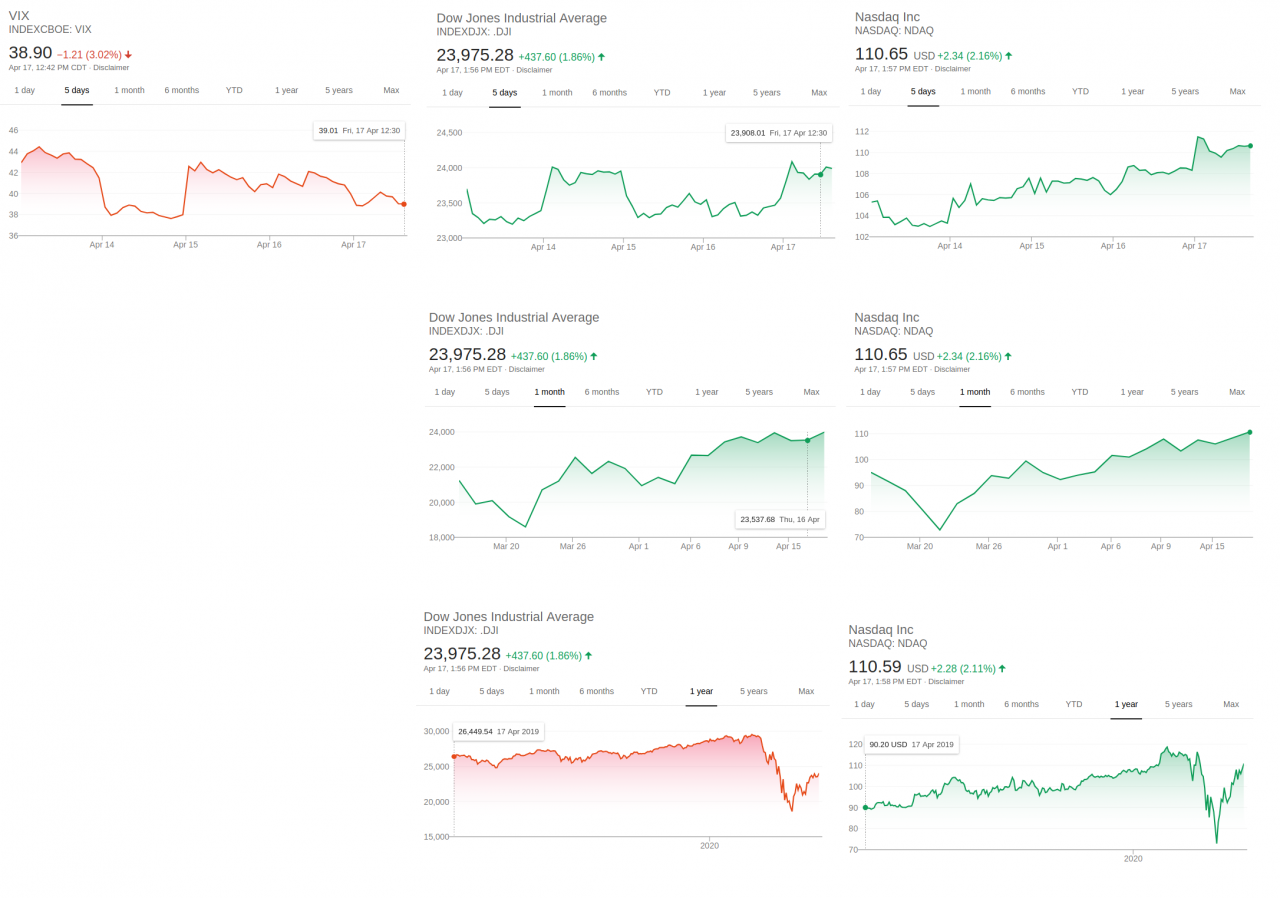
Friday, April 17 the markets continue to basically hold. Up and down 2-4% for individual stocks in general, which is kind of where things were at before March, and some up and down 8 or 12%. The NASDAQ less troubled than the DOW. Yesterday I think the DOW was down 2% and NASDAQ less than a percent. My current ignorant hypothesis for what's been happening is that although there have been negative events, there hasn't been overly negative sentiment or hopelessness enough to counter thoughts of profit or FOMO. Every couple days the Fed has come out with positive news. At first it was false optimism about the virus and how things would go, then it was regular stimulus packages, bailouts, lots of Fed debt purchases. Then there's been talk of plateauing of numbers in coming weeks. In order for things to turn down again it might require negative news without positive counter-news. This would be a longer task. People I don't think are too worried because they're still out in the streets quite a bit. Here it seems more and more, although they officially extended the lockdown until April 3. Bottom line is stocks are not at cheap prices. They started to look a bit cheap a few weeks ago at their lows, but now don't.
There are around 20m unemployment claims in the US to date now. Most recent company reports have numbers for from before, and effected numbers will start coming out in coming months, but will people consider them to be very short term or not?
Oil is around $28. Gold down 2% today but up 16% for 30 days. Silver is up 28% for 30 days by the way. Bitcoin at $7050.
Something I'm curious about is what happens with banks now? Financial stocks are down. 0 percent interest rate. I guess banks could use their money to invest in stocks and businesses with yield, but why should they do the business of loaning at all? Does credit collapse now until something else is put in place?
Also, what about the decisions that were made based on the assumption the US Fed would not cut rates to 0?
Steve Eisman last October talking about the European 0% rate said it has created global overcapacity, because every stock buyback has been done, every deal has been funded, every PE, every venture capital, every startup has been funded, so you have global overcapacity and deflation, and didn't know why doing more of the same thing might cause inflation, which the ECB was trying.
One of the things that might be predictive is a better understanding of the multiple. What is it tied to and where is that factor at now? Most investors are basing their buy-sell assessment on 'how high' the price of the stock was up before March. But looking back the multiple might not be high, it might be low based on new understanding of how the multiple fluctuates.
Saturday April 18 there is a lot of scientific data coming out now. One of the effects is people who have been analyzing events such as Dr. John Campbell are changing their views on some things. For example, according to new data on testing populations for antibodies, 10000 blood donors in Holland, 400 homeless people in a US shelter, 6000 randoms in a California city, percentage of people of those infected who have symptoms may be lower than before thought and the death rate also lower, and Campbell now is recommending using masks in public whereas before he wasn't, due to the number of people he now believes are asymptomatic buy contagious. I think these results are too premature though. For example, of the 400 homeless tested of which 40% had antibodies but only one had symptoms, it is possible they were all recently infected and haven't developed symptoms yet, among other possibilities.
In my city, although it is Saturday also, there is less police patrol presence than in past weeks, and quite a lot of people are out and loitering, and some vendors have come back out.
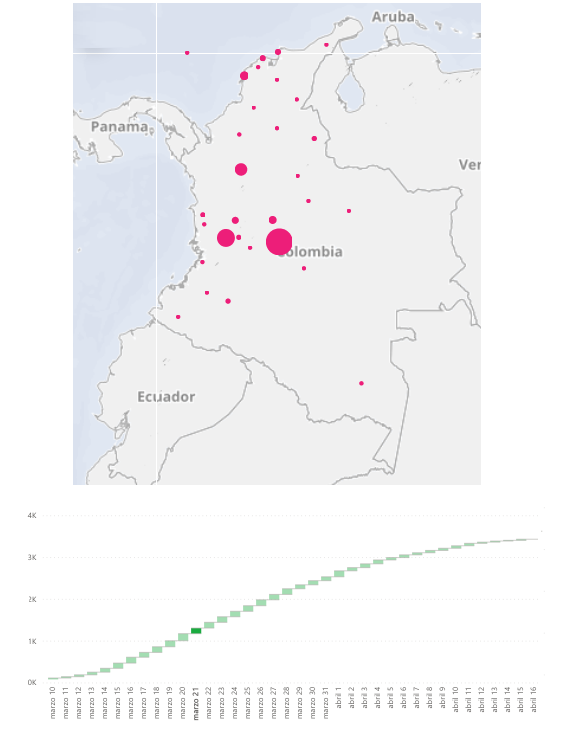
For whatever reason, testing or incidence, there are now cases in more areas of this country known, whereas before it was apparent only in the biggest cities. It seems this last week there started free buses to the Venezuelas border so Venezuelans can go there. One of my friends went yesterday.
Some countries like Germany are reopening schools and shopping malls, while continuing to ban public gatherings, and aiming for a particular R0 (reproduction rate) infection rate of 1.2, attempting to use testing, contact tracing, containment and education, with a general aim of opening society and wanting some ongoing infections to continue to build herd immunity at a rate health services can cope with although with some deaths. The word being used for this approach is titrating.
Spain and Italy are opening some things like construction, book stores, children's clothing shops, after their numbers are slowing down.
In Western countries, a high percentage of deaths is care homes. In France half of the 19,000 died in care homes.
Some information is suggesting death rates may be higher in some areas of South America.
According to a WHO official, some people don't seroconvert (don't produce antibodies and immunity).
There are currently 70 teams working on vaccines, so there might end up being a dozen vaccines for Coronavirus. Oxford says they might have a vaccine in September, a year earlier than thought.
People are studying the origin of Coronavirus. A couple weeks ago there were some headlines that it had been found not to have come from a lab, to have come about naturally, 'zoonotically.' How reliable were the sources? I don't remember what they were. Turns out the wet market where Coronavirus was first passed to people from animals is about half a mile away from a microbiological research facility. While many would have called such consideration 'conspiracy theory' otherwise, because the US and UK are both studying it now, it is to be considered 'not conspiracy theory' showing how dubious the distinction is.
Market experts are still, the few who comment, expecting another test of lows, but saying it's another year before returning to normal for business, and that a lot of companies won't make it, so to invest in some companies but watch the Z and balance sheets. To me it's starting to look like time to invest. There is so much money out there people have nothing to do with BUT invest, it seems, and regular folks have been passive investing in the stock market for years now, and if some companies are going to fold that means others will take their market share, and if the stock market is pushing further and further the valuation on returns (years ahead and at higher multiples of expected earnings), it looks like there won't be anything coming along to really shake them up. There will be low revenue reports for a few terms but I can't see what else, except the problems caused by 0 interest rates. The lows were March 23 and things have been rising since, despite the 'greatest global pandemic in 50 or 100 years, predictions from some like the IMF of the worst recession since the Great Depression, and the consumer economy is completely shut down.'
112 of the S&P 500 are higher year-over-year right now, and the S&P is trading at 22x, historically rich. Although some you might expect, J&J with pantry stocking, a handful of tech companies. Some companies are declining to do short term earnings guidance, and it's been debated for a long time with long-term investors wanting no short term but only long-term guidance. Short term is less relevant and creates stock volatility. Only 1 in 5 companies do guidance at all. And all companies still have to do quarterly earnings reports legally.
Sunday, April 26 the markets basically held last week, moving on Coronavirus news and oil developments.
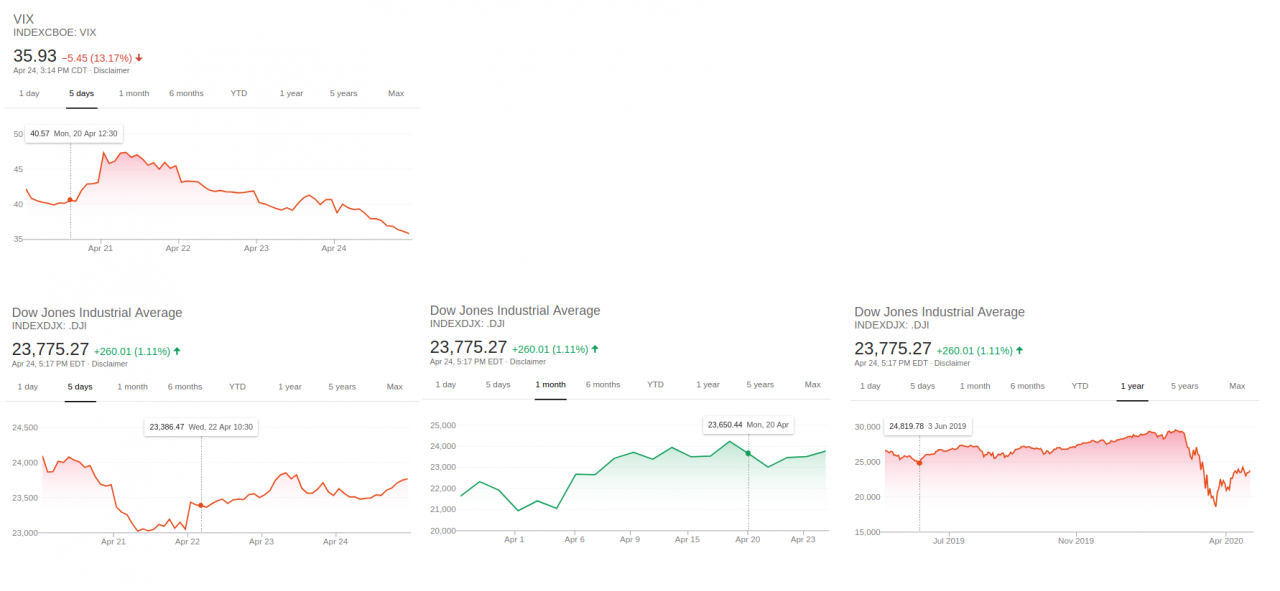
The question I have now is if good news will continue to issue from the US government to buoy up every negative report that comes out, as perhaps has happened continually since March. At least with the Coronavirus, every few days the US government said something encouraging to the economy about what they would do in terms of giving and lending money to companies of all sorts. The package was exhausted this week. The minimum loan was $1m, which meant it wasn't suitable for many small companies. A couple of companies that received such a loan gave it back, with statements about 'the companies that need it should take it.' There's the issue also of the effects of taking such a loan, giving such a big stake, to the government, and the results for shareholders, particularly if the company doesn't really need the loan.
One piece of news last week was that 'there might never be a vaccine,' according to some UK researchers. That corona viruses were notably hard to vaccine. Stocks went down. Another news item was that sunlight kills the virus, so summer would have an effect. Markets went up. Some of these stories are obviously not groundbreaking or complete in the picture they present (one-sided positive or negative statements) and you might wonder if they're engineered to manipulate the markets predictably.
What surprised economists wasn't that the government would buy corporate bonds. That's all they could do, economists say, and while you could argue at length about whether it was done well or not well doesn't change that. What surprises them is that the government would buy high yield. There are questions about a 'zombie market' and inflation if the US government keeps pushing out money and producing new money, although it's fairly certain the US dollar will continue to be the strong world currency and that the US government and companies with good books will continue to do well, with an economy that beats out the performance of emerging markets. In other countries, companies will fail and the government won't be offering loans or bailouts.
Another news story this past week was Trump in a press conference spontaneously said something like they were working on injecting people with Lysol or other cleaning products to clean them of the virus. People made a big deal about this, of course. That he'd think this I wasn't surprised. He has no medical education and I think everyone might think at some point in their life, 'Can we clean blood with cleaning products, if they kill germs and dirt so well?' His life experience is in business, and I doubt he's done ANY reading outside of his life, and I doubt many people would, if their life offered doing high millions deals, meeting with famous people and playing golf with them, sleeping with models and beautiful women, buying whatever you want. My concern would be that if he's rash enough to say something so uninformed without realizing the stakes of the type of thing, what about other areas outside of his expertise, such as international tensions and actual situations that could break out into war? Maybe it's fortunate we're not in a period of history where the big countries are disposed toward war. This is the same concern I had when he ran for office. I thought then I preferred him to Hillary (although my preference was Jeb Bush from watching the debates, until Jeb dropped out) and thought Trump at least wasn't a politician, had some abilities, and could probably do some good economic things, compared with Obama and the socialist directive that discouraged business people. But my concern on his possible election (I thought he would lose to Hillary probably, until the very end) was he was rash and maybe not that sharp (although possessing abilities that either are or are like wisdom) not a politician and that could contribute to a war. My real hope besides improving business was a leader (this is always among my top hopes) would do something positive in law and human rights, but I guess I shouldn't expect this from Trump. I don't know if he understands anything about that subject, and would possibly also not feel confident in doing something there for this same reason, although I suspect he would naturally fall on the side of human rights in most things if presented with cases, which isn't the case for many, and is something I like about him. He could be a guy's guy. Is, probably.
Unemployment figures continue. Mortality continues. Lockdown continues. It's extended every week or so by another week or so, so that the lockdown always is scheduled to end in about 3 weeks. They've began alternating the days people in my city can go out based on their ID card's last digit. More and more people are out, and police sweeping them away happens less. It happens in the park downtown maybe a couple times a day, whereas during the first week or two, almost no one was on the street even in the absolute downtown.
Big US banking authorities are saying the date of reopening the economy is later than the government says, with this summer being the earliest date. And returning to normal being a couple years away.
Brent is still around $22.
I barely watched or read anything on the economy this week, just the odd thing here and there, so I can't comment at length about what people are thinking.
Monday, April 27 it seems some commenters who have been updating people on the virus since the start have hit another phase, where they express surprise masks aren't required everywhere (although up until a couple weeks ago they said they didn't help) and there's a lot of hindsight, 'Why didn't we shut off flights from China immediately... measures that seem now trifling... if there hadn't been a cover up in China... the WHO didn't do this or that,' etc.
Another comment was about the stereotypes some Westerners (for me Westerner means Northern Europe, US, Canada, Australia, New Zealand where the same general culture is) have of southern countries like Italy and Spain and how 'impressed' some were about how seriously Spain etc. had responded, it's people, compared with northerners in UK and Germany. Because they have a stereotype for laziness and unseriousness. I would guess, from my experience, most non-Western countries are more serious about simple things like health, cleanliness, religious adherence, etc. What distinguishes Westerners from the rest of the world (except Japan) is our ability to produce work. This includes self-control, internalized social responsibility, trust, an environment of fairness, and also an idea that hard work is good to do. We have I think a lot more people set on and never thinking otherwise from being a laborer and employee, whereas most nations everyone wants to be an owner or perhaps specialist. We can easily confuse these things: the 'unseriousness' of other cultures because they don't come through on commitments, their words, work, etc. I don't have this totally worked out though.
Market up 1.5% today. Almost every stock on my lists was up. A lot of talk seems to be about how the effects will be long (by that they mean a year or two), recovery might be slow, not just flicking a switch to turn the economy back on, and the consumer who had been spending 90% of GDP in buying might not have the same attitude when he returns to the market. Market in the US may contract 15 or 30% over the year and over this second quarter. At the same time, corporations that were able to stay in business, and those that will benefit from reduced competition, are being seen as looking good going forward, although not necessarily good stock buys because their stock prices are very high based on earnings value.
Some talk about disruptions in the supply chain for retailers. Meat producers may have to reduce how many animals they have. Meat may get more expensive in the US. Along with this, employees had been criticizing some big companies for having given them confusing instructions or directives a month or two ago, such as continuing to go to work with mild symptoms, inadequate protective equipment, etc.
In a scientific report on 5700 hospital patients in NY, the most common comorbidities were high blood pressure (more than half), obesity (42%), and diabetes miletus (sugar) (34%). Then after those, coronary artery disease, heart failure, asthma, cancers, kidney disease, liver disease, HIV, those who'd had transplants. Less than 1/3 came to hospital with a significant fever. 20% had breathing issues. 63% were men. Those who went to intensive care were median age 65, 2/3rds male. Of those who were mechanically ventilated, 97% died. Under 65, 75% died. Under 18 no one died.
Usual cost for a vaccine: $500m for an easy vaccine, $1-2B for a harder one, based on a 5-10 year timeframe.
Thursday, April 30 more people on the streets now. "Venezuelans," says the woman who works in my hotel while cleaning my room. Because they're there every day, although the one-or-two-days-depending-on-your-ID-card thing is still in place. A few more stores are open, mostly that sell food or beverages or anything tied to health products. Maybe what the government is doing is saying 'We can impose stricter quarantine if we need to again later. For now, new cases are increasing but at a steady enough number (I think a few hundred per day in the country, confirmed tested people). If some more people get it, it will be OK because they can more-or-less prevent it if they want to or they can take chances.' I'm not talking about people working to eat. I mean people who are just out and about.
Yesterday, numbers showed the US economy shrunk at a 5% rate for the first quarter, and stocks went up a few percent, on news the malaria drug worked on some types of patients and on word from the government they would use all the tools available to them to restart the economy. Today they're down over a percent. Pretty much a stable area it looks like.
Gold is at $1686. Brent went up 12% today to $25. Bitcoin is at $8700 USD.
'What the Fed is doing is extraordinary, unprecedented. To federalize the financial markets, to override the price mechanism, to substitute its judgment for that of disinterested people conducting the business we call price discovery.' - Jim Grant, interest rate observer
'That the Fed can be a quasi-fiscal agency, that it picks winners and losers.' - El-Erian
With the Feds huge moves, Main Street is disconnected from Wall Street. The Fed has gone into high yield. Central banks aren't supposed to take on credit and default risk. Economists think we'll come out of this in the US with massive entanglement of the Fed and the government in private sector activity, and we'll come out with higher debt, lower productivity with rewiring of supply chains.
The US is at 30m jobless claims over the past 6 weeks.
Market news commentators have got their stride back, and are sounding more confident again, not because they can say anything about the future, but because they have something they can talk confidently about, the past. They can analyze the past two months and say this happened and that happened. Of course, I mean they're saying nothing. I didn't see any experts over the past two months who could or did predict anything that happened.
We've seen how the new cases increased rapidly but then when measures were taken they didn't decline as sharply as some may have thought, because lock down was leaky in Europe and the States compared with China, Taiwan, South Korea, Japan. What has happened is numbers have leveled. Because people and economies can't sit in lockdown for 6 months while a vaccine is developed economies reopen after a certain period, maybe a month or a couple months. Places in the states are reopening now. My city there are more shops open. More people are out on the streets. They're told to leave the streets less. Since there is a window of what people and economies will bear in terms of putting their lives on hold, it might be best to make that period stricter, where no one is permitted to do the things that spread the virus. If the period is a couple weeks, if everyone obeys lock down that should be enough to stem it. Three weeks maybe if the people who interact are steady for those three weeks, as they will catch it from those they interact with but not spread it further. Instead, the leakiness means the lock down is not very effective except to keep new case numbers manageable. It seems like an approach if you were thinking to maintain it for an indefinite period (or until herd immunity takes hold), whereas a strategy for a short term lock down would be stricter.
Friday, May 1 the Dow went down 2.5% today and the NASDAQ 2.7%. Commenters are taking about the possibility investors were covering short positions because they couldn't understand otherwise so much selling, particularly of stocks considered fairly safe like Amazon and Google.

The reasoning behind Sweden's approach to Coronavirus, ie no enforced lock down although it has advised steps and a sort of mild social distancing regime, was that they would take no steps that weren't evidence based, so they advised hand washing, but border-closures, school closures, social distancing, there's 'almost no science behind it.'
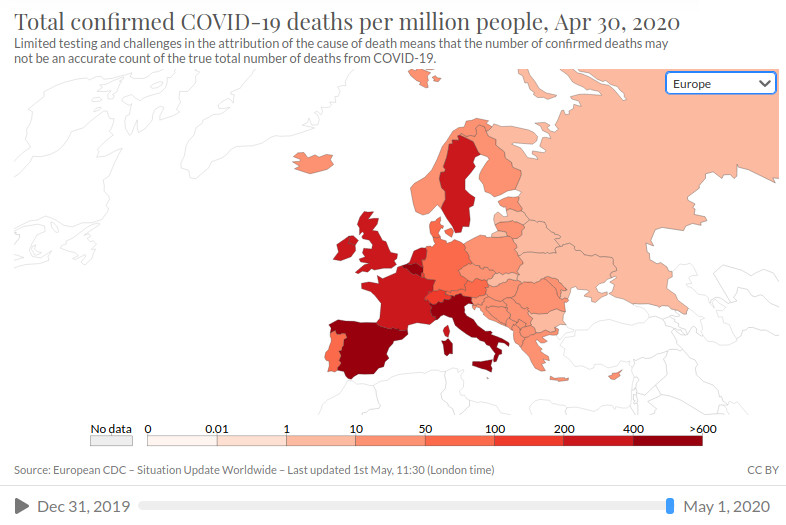
Advisor to the Swedish Government, in response to people saying the reason the curve in the UK has flattened is the lock down, and asked what else could it be: 'One thing is immunity, another is that the people who are frail and old will die first, and when that group of people is sort of thinned out you will get less deaths as well. The other thing is that when you start your exit strategy, you'll have some other deaths that we had already (I don't understand what he meant here). He thought the overall numbers looking back would be without much big difference between countries that had and hadn't done lock down. He thought the mortality rate of Coronavirus would actually be around 0.1%, around the same as a severe influenza.
When asked what the UK should be doing instead: 'When I first heard 6 weeks ago about the different draconian measures that were taken I asked myself how are they gonna climb down from that? When will they open the schools again? What will be the criteria? Did any of the very strong and decisive politicians, which is very important for politicians to show, force, even think about how do we get out of this when they introduced it.' He said that you couldn't keep a lock down waiting for a vaccine, 6 months, a year, longer, in a democracy for long, before people start saying 'No I'm not taking it anymore,' although you can in China where you can tell people to stay indoors and weld their doors so they can't get out. In a democracy after 3 or 4 weeks people will say 'Well I don't know anyone who had Covid and I want to go out, I want to go down to the pub.'
He said that while some would die now rather in a few months, what he was most afraid of was the dictatorial trends in Eastern Europe. Hungary now had no finishing date for the leader now. He thought the ramifications can be huge from this, and we don't even start seeing them.
He said what Sweden should have done, he said they failed because they weren't on their toes enough, was protect the old and vulnerable people quickly. They should have banned visitors to nursing homes, which in Sweden are large relative to some countries like Norway, and their nurses are often foreigners who don't understand clearly messages that have been spread to the public because their Swedish is not perfect. He still thought they should protect the older people and just let the virus pass through the population. He said countries that were successful, like Korea, can't maintain their policy, and that they are just delaying infection.
The news we get access to really is quite one-sided usually, as the Swedish expert's comments highlight. With economic and market news also, which may in part explain why it doesn't help much in predicting anything.
Bitcoin went up 20% to $8850 this week. Gold went up 4% over the past month with some ups and downs to now $1700.
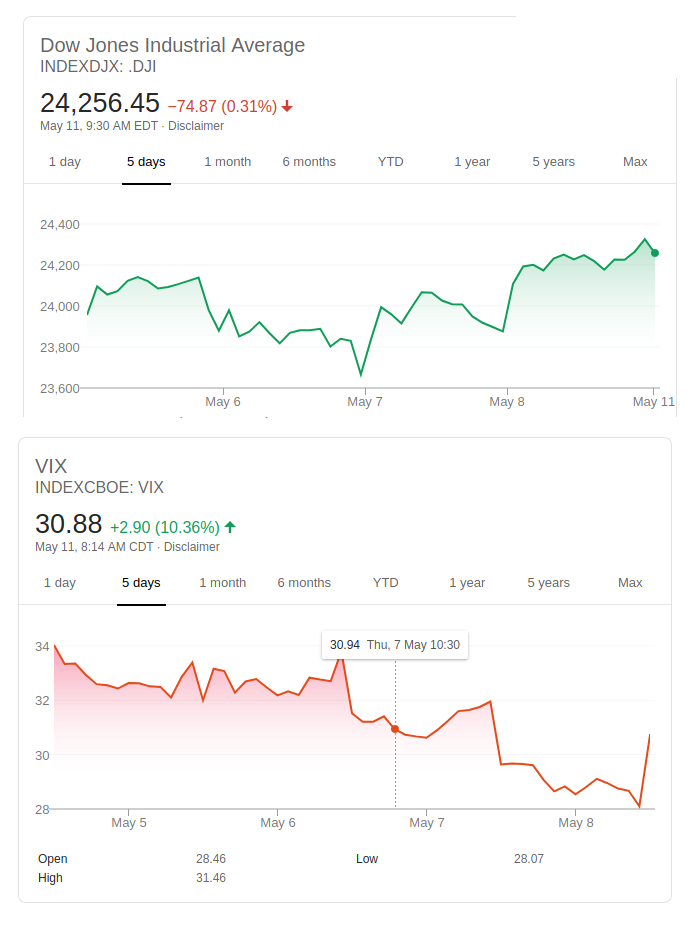
Thursday May 7 I went back into a few stocks, cruise lines. For people who didn't enter the market last month, they might look stupid because the bounce has been so strong. We weren't looking at the right things, and still don't know really what the things that mattered were. Listening to experienced analysts didn't really pay. The stocks I went into are ones I've been wanting to enter since this started because they were so hard-hit, and my expectation is in the next two years they'll be up to where they used to be. They might go up short-term depending on how investors think about them, or they might go down, but you have to enter the market sometime and it might go down after you do. The last two months have demonstrated the value of the strategy of buying incrementally as a market goes down. You can't predict the bottom, and if an investor buys an amount that leaves them liquidity and that they think even if the market goes down now in a couple years it should be back up, and then does the same if it drops again. I'm not great at the stock market, and haven't really been watching it, but there have been some real profits for some investors watching the right stocks and moving on them. Some people have already seen 5x on some of the stocks that they bought at the beginning of March. I wonder if experienced investors, the older guys who've been successes and have 30 or 40 years experience now did poorly because of their expectations based on the past. Perhaps this event is different. Or the market could be just ahead of another drop.
I went with Norwegian (which recently plunged on a headline they used in their filings a line about 'substantial doubt' about their ability to continue as a 'going concern' although there was smaller headlines about them securing funding that would allow them to continue to the end of the year with no revenue or something. The other cruise stocks went down on the same Norwegian news. I also went with Carnival because its dividend is bigger than Caribbean and because SA bought that bit of it a month back, although Caribbean is said to be a stronger company from what I've heard, and Carnival was slowly declining in value for a long time before March. I wanted to also buy Caribbean but I can't get through to my bank still (last time I tried was weeks ago) to try to understand a question with something.
Some news here has been showing video footage of protests in Panama against the lockdown, who want to open the economy and go to work because they don't have money for food. The videos didn't show large crowds, but seemed to show a few different sites, so I'm not sure how big this group is. Some states are opening back up. Our quarantine seems to be extended to the end of May currently, although there are more people on the streets. Yesterday afternoon I walked by near the park and it looked pretty full from my angle.
Mark Cuban has been in a couple of headlines as a potential Presidential hopeful. Maybe Trump opened up politics again for personality candidates. I don't know that much about Cuban, only a few interviews, but he seems stable, energetic, adventurous, experienced, not too ignorantly strict or prudish, has a footing in business, the market, tech, and other business sectors, and has done some partying and enjoying of his life. I think he'd be a strong candidate and probably would be better able to handle Trump (although he won't be up against Trump because that election season is already on), which is something the politicians in the last Democratic group couldn't. Another possible person some might put forward is Musk, a once in a generation entrepreneur, the products he makes second to none, category killers, category redefiners, but I couldn't see that as a good thing. He's someone who stands out more than almost anyone in the serious realm (non entertainment and sports), but he's not stable and responsible from what I've seen. He's more of a Loki-type figure, doing big things, adventurous. The other day he tweeted a rant about opening the US economy again with strong language like 'forceably imprisoning people' and 'fascist' and 'give people back their ****** freedom.' Tesla went down and lost $23b in market cap when Musk saying Tesla was overvalued. People seemed surprised but Musk has been saying similar things in long-form videoed interviews for years, although maybe people don't remember or didn't listen to them. The issue I see is that it's probably not responsible to be so exacerbating on a big, more or less sensitive, issues like that. Rather dissent should be expressed calmly, in order that a unified feeling for the country can be preserved, while it takes either of two options, neither perfect, while considering the other option and the possibility to change to that other option at any time. Musk and Grimes just had their baby, and named it X AE A-12 named after Grime's favorite song. I think Musk is benefiting from the same thing I thought Trump benefited by though in establishing himself as flawed, possibly a bit crazy, and having negative points or attributes from the start, or from the times when they have successes and are viewed positively nomatter what. By saying crazy reckless things, or ignorant things, or being exposed for doing bad things or behavior, they are later immune to it in a society which is extremely ignorantly prudish and hardline, where a person can be taken down if they build a reputation for the flawless character nowadays expected of their position when some true or false information comes out to the contrary. This has the other negative effect of providing us only with extremely inexperienced people who've either been so boring they were never interested in doing anything exciting or lived a full life of denying themselves these experiences, neither of which produces an understanding, calm, composed, roll-with-the-punches type of person, but more likely a reactionary, judgemental, harsh, ignorant and inexperienced one. Back to Musk and Trump, by establishing themselves as erratic, compulsive, crazy in their statements early on and consistently, they make their lives easier to move around in going forward, as well as increase their durability to shattering.
90% of a stocks value is for earnings more than 12 months in the future. They're the longest-lived assets.
Monetary expansion, M1, money supply, has gone up an unprecedented 19% in 6 weeks, more than in the year that followed the September 2008 Lehman bankruptcy. Some analysists think that might contribute to a boom year 2021, as well as more inflation than the US has seen in 2 decades, maybe 3 or 4 % inflation although that may seem impossible now because prices are going down so much.
After WWII military spending was going down and some expected another depression, but the Fed had built up a ton of liquidity and that exploded in consumer spending and raised the stock market.
Big cap stocks may not deserve P/Es over 50 or 60 because Bubble at that size they can't grow enough at the far end to justify. In the 70s and the Nifty Fifty, Polaroid had the highest at 90. In the peak of the Tech Bubble the average S&P tech stock was 90x earnings. That's tech, not the crazy internet stocks. P/E or adjusted P/E that projects real returns on the market going forward.
From the beginning of the federalist period, the states were to be sort of laboratories which can do different things and people would note the outcomes and move toward the best practices.
The USD is effectively the only reserve currency, where other countries have keep their reserves in it in order to make their payments down the road, which means they have to invest it in instruments, and countries will lend the US treasury dollars at 60 basis points for 10 years. Over half of US debt is held out of the country by central banks and other institutions.
People are thinking about the bailouts and whether they should take government money, when the focus of the government is getting the economy running in a crisis and if some money goes to the wrong place we'll just tolerate it. Later, as things cool off and the anxiety isn't there any more, people will look at which companies took money and whether it was where the money was intended to go, if they really needed it, and there will be some resentment.
$4t of liquidity has been injected into the US economy, $3t of stimulus. This may be 60 to 90 days of funding.
The government already is a partner in business, owning 21%. Used to be 35%.
Some investors think bankruptcy's which would otherwise happen won't perhaps, although bankruptcy are what's necessary to clear markets and to end recessions and dips, the ability to clear the market. There's a lot more distressed players today and that will help clear the market, but it also means there aren't near as many opportunities as there were in the past.
Many seem to be commenting that the memory of this time when they were in lockdown will last a long time in people's minds, and might change how they act when it's over, for a long time. I'm not sure about this. I've never met a person who tells me they get a cold once or twice a year. Everyone tells me they get colds 'very rarely' or 'almost never' and that they usually get mild symptoms. Yet of course they're getting a cold once or twice every year like everyone. There seems to be no memory for this type of thing. Event-wise, perhaps there's a tie-in with the disappearance from national memory of the Spanish Flu in America a hundred years ago.
As the air clears and some looking back is possible, some are becoming highly critical of China and in particular XI. After the outbreak, which some think was a case of China accidentally losing control of some biological research they were doing in a lab paid for partially by the US, held a meeting about it. Xi closed off travel from Wuhan to other parts of China. China didn't close off international travel of Chinese to other parts of the world. When the US closed off flights from China, the Chinese press called this 'racist.' Interestingly, while in the US the government is not responsible for anything the press says, although it has a hard time because of the relentless press criticizing it, in China the press is the mouthpiece of the government and the Chinese government is responsible for what it prints because the government directs what it says. The WHO may also now be considered sort of a mouthpiece of the Chinese government, as many are looking at it that way now. Also, China has issues statistics which the US press has reported on saying the US isn't doing as well as China, which may or may not be the case, there's no way to know. Now, China attributes new cases to people bringing the virus back into China from overseas. During the past months, China has stepped up renaming of the Spratly Islands in the South China Sea. They may also have resumed low- or no- yield nuclear testing which is outlawed, although this isn't reliably confirmed. And reportedly they cracked down on Hong Kong. China has also been 'attacking' all other nations through cyber, although perhaps other nations have been doing this bad as well. Hate for China might go way up, as it hasn't stopped being a shitty country since whenever it started, but now it's big and powerful, creating fear, and declining in economic power, losing the people who wanted it to succeed because their fortunes were tied up in it. China probably won't want a war, though, as it would face probably everyone, with the US's nuclear capability, a technological Japan and South Korea, a no-nonsense Australia, a competitive India who isn't happy about borders, and I would guess Russia would rather live in a world with the US than with China although it could never say that, because Russians aren't stupid, which is the same reason they maintain relations with China. Maybe China would have Iran, and maybe Pakistan could be brought in against India, and perhaps lines could the be drawn along the Muslim Middle East. This is all because of Kissinger and Nixon, perhaps. Some say that what has happened with Coronavirus is a moment when people have seen, in that moment, what kind of regime China really is. Some say everyone has their pet Chinese complain, military, economic, financial, human rights. The left defends China against the right, but the left turns against China when issues of human rights violations come up, which are woven thickly into China, such as researchers disappearing, information disappearing, people deliberately exposed. If there's no war with China, perhaps all this criticism will lead to a collapse of the Chinese government to be replaced with one on the basis of human rights, which they'd be ineffective at implementing at first but over decades perhaps would turn a tide, although it might mean shrinking of Chinese ability to grow economically in their style which doesn't consider the value of people, which on the other hand would create favorability in them which they don't have now and that would perhaps give them economic power of a different sort.
At the same time the US can't easily decouple from China, as China has a hold over the supply chains for things America needs, and the US can't just become autonomous easily. Medicine, military technology, food even in our grocery stores. They have a ton of cash, as well as investments in most US companies and international. Tons of Chinese are enrolled in US colleges. In this way China differs from the US's former adversary the USSR. China also, so far, is perceived as a victim of racism by the US and other powerful white countries, while the USSR was something Americans had no problem blaming or attacking.
Some think Trump will run on 'against China' because with the stimulus he can't oppose democratic 'socialism,' the economy might not recover quickly, and he will face criticism for either opening or not opening the economy. He ran warning about China before though. Some say Trump's greatest strength in the coming election is the lack of any Democratic leader. Their top ones were Joe Biden who is so thin and empty it seems and has shown no ability to do anything in terms of leadership, and Sanders who was a bit of a detached dreamer.
Of jobless claims, low-wage jobs have been hit at about 20% I think and higher wages about 8% I think.
Thursday, May 14 and the Fed said this week they're going to buy ETFs they announced. Corporate debt. Propping up the bond market in 'the most efficient way' as a last resort, adding liquidity to the bond market and ETFs, taking out price discovery. They may or may not say what companies they buy, but the news has already had an effect. The Fed is the bond backstop for the foreseeable future, is how some see it. This makes sure people who want to sell will have a buyer.
The Fed is saying it doesn't want to go to negative rates but people think we're going there. Negative rates are going to be priced in. When Japan and the ECU did this bond liquidity disappeared and is 10% of what it was 5 years ago. There are days when Japanese government bonds don't trade once. All the private players and brokers and dealers go away when the market is taken over and nationalized, it becomes a permanent fixture of the federal bank or the government itself. The Japanese can't do anything with it with their markets and their economy. Trump wants negative rates, and has been touting them for a long time. Before, some thought of that as brinksmanship, but the economy has changed since earlier this year. Negative rates haven't been great for the European economy, and analysts think going to negative rates signifies that something is wrong in the backdrop. It's problematic for financials and other parts of capital markets. There will be a move toward no growth, and investors will then be driven toward high growers, like Uber-cap tech companies, large-cap growth companies, a nifty fifty or nifty five type environment, and steady earners, like utilities. If you have negative rates, you can justify a high multiple. A bad environment for bank multiples, EPS growth for banks. Banks can't operate that well in this environment.
I put 10 or 15% of my portfolio the other day into cruises, Norwegian and Carnival. I'm looking at Delta also, and would like to go for Shell if I could find out something about their prospects near and far. And Walmart, which hasn't dipped and is continuing up and has a small dividend. The cruise stocks went down that day and down today but then came back up today to break even, as the whole market went down today and had a sharp reversal mid-day. I didn't check why. Other companies I would like to own have already recovered too much and I would feel unsafe if there was another drop.
I haven't been paying much attention to stock, economy and investment news recently, so can't write much about what people are talking about.
The airlines are being told by the government that they gave them a bailout, or what might be thought of as an unemployment benefits policy, that have to leave the middle seat empty, but they can raise fares if they want. Airlines received a lot of money, but this money was to pay workers for another whatever six months, when otherwise they would have decided to cut back on flights as much as possible, reduce staff, and cut costs as much as possible, so are saying the airline bailout was not thought out well. The money keeps the economy functioning, obviously, but what is the role of a company here? Should a company take on debt to pay for things it can't use to make returns?
Analysists have said the best is Delta, and what the company may do is go after their best customers, rather than as much budget stuff, and this could be how they get through, meaning less flights. It has a sock full of $10b in debt. Delta and Southwest both entered this with investment grade debt across all credit rating agencies. Domestic flights will come back sooner, so those like UAL with exposure to asia will have it harder.
Some states are building up infrastructure to exit lockdown more safely, like Massachusetts, which has hired work from home contact tracers who call around and try to break chains of infection. A point people look to for reducing numbers, not just slowing transmission, is testing.
The issue has become political in this way. If you want to go back to work you're a republican and if you're a democrat letting people go back to work is committing murder. Sort of like abortion, gun control, physical discipline laws.
Talk of tech and other companies who've in the past 2 months got a crash course in how to manage people remotely, can see which people are crushing it and which aren't and will be able to cut some of them and have a stronger company, and also the high cost of managing people face to face which is that they have to live in the big tech centers like SF where rent is like $4k a month reportedly can change that, and just say hire anyone who is good wherever they are and we can manage them now. Maybe you hire staff at a third of the price. I think maybe Twitter left SF and just said we can work from home from now on. SF hasn't built new units for living and real estate has gone up and up. Some say the government is inefficient but I suspect they probably just own property and know they can drive up their wealth if they don't facilitate new dwellings, which is something people from Canadian cities is probably familiar with. Anyway, it might revolutionize how people find workers and get hired and work. Where will the companies go? Low tax states with easier government bureaucracy where it's easier to do things, names I heard are Nevada, Miami and other parts of Florida, Nashville and other cities in Texas, Tokyo. I've been to Nevada and I could see that. Nevada seems pretty great. Although LA still has way more to offer than Las Vegas. I was only in SF like a day once so couldn't say how valuable being situated there must be.
People in the last crisis, which was a credit crisis, but still people had to borrow just to make ends meet and afterwards didn't borrow again for 10 years because of the negative experience, now, although money will enter the economy, people will take that money and save it rather than spend it because they're thinking they might want it for a rainy day, or for paying down debt. People coming out of this recession will be saving money, if maybe not paying down debts. Inflation then may not be a big problem, so the central bank may feel comfortable putting more money into the system.
Continued in Part IV ... (click here to link there): http://tttthis.com/edit/blog/talk-of-recession-and-coronavirus-2020-part-iv
Related material:
https://www.businessinsider.com/saudi-arabias-sovereign-wealth-fund-buys-a-stake-in-carnival-2020-4
https://www.carnivalcorp.com/node/61031/html