Actors
- Brad Pitt
- DiCaprio
- Woody Harrelson
- John Hamm
- Keanu
- Mel Gibson
- Shia LeBuff
Actresses
- Dakota Fanning
- Francis McDormand
- Jennifer Tilley
Directors
- Quintin
- Sarah Polley
Writers
- Quintin
Actors
Actresses
Directors
Writers
Weinstein was convicted in a mixed verdict of 12 jurors (why are they using a jury?). Here's what one said:
"It wasn't rape in the first degree. There was no physical compulsion with the threat of bodily harm or death. But there was no consent given, despite a lack of physical resistance, and a reasonable person should have known that there was no consent given in that instance."
Convicting people of a crime even if the person doesn't attempt to turn away from sex or kissing or whatever! Accepting it, and then calling it a crime? Western law is unbelievable.
Basically every person who has kissed their husband or wife or partner, or an acquaintance or friend, when they didn't respond by kissing back, or even if they did kiss back (presumably Weinstein's partners may well have done so) has by this definition committed sexual assault.
In 2019 I wrote that I considered Hong Kong the biggest story of the year. It's almost March and I think the story of the year, barring any large event, will be the "talk of recession." We don't know if we'll have one. No one does. Every economist I've seen says there must be one, but has been saying that for a long time. Saying it picked up last summer. There have been a few big dips in the indexes, but they're rebounded each time to new highs. (A week later, that this story would be the biggest - Coronavirus more than the recession, perhaps - became globally obvious.)
February 24 and 25 the indexes lost big. Gold had been going up over the week, perhaps as people anticipated a close proximity to a regular cyclical recession, but it went down on the 25th also. All (except one, of those I was watching) of the gold mining and silver mining, etc. stocks went down, after going up for a few days.
The talk is about the Corona Virus. It's a type of economic event no one had considered. The hardest hit stocks were those to do with travel and being in public, like airlines, hotels, and concert event promotion (energy is also said to be a bad investment), but all stocks were down except for a few. Mostly around 2% - those hard-hit ones around 8 or 9%. The idea of this type of market influence wasn't talked about before. The coming recession was going to come, everyone was saying, because it had to and always does as part of a cycle. And that once interest rates went to a certain point (they're very low), something would happen. However, a recession won't start while the consumer is still spending, and he didn't stop.
No one ever can predict stocks or the markets. No one ever has. Well-known investors were either in the right thing at the right time, or have been doing it for a long time and have just held good stocks. Over time most stocks go up. If they've held stocks for 20 or 30 years, those will be way up. If among their stocks they have something that had a huge growth, and people talk again and again referencing that particular one story.
So I don't say that a recession will be the 2020 story, but the event is the talk about what no one knows, that everyone is watching, that is a significant event for all of us, the 'talk of the recession.'
I was about to invest in YUM and gold. YUM performed in the 2008 recession, and has shown a steady increase since before it. It includes Taco Bell and a popular pizza chain. I was thinking about a recession, but not about this type of recession, where people aren't spending because they don't want to be in public places. Word is Corona Virus will stay through summer (whereas other types of viruses abate in summer), but at some point will run its course, unless something changes (a mutation or something unexpected). Reduced spending I guess could compound as businesses have less to spend as a result etc. Or it could bounce back. Unknowable for most of us. I expect that'll be a better time to invest in anything. People have also talked about certain gyms being good investments if the recession came, because these gyms are really cheap, like $8 a month, and they thought people would be unlikely to give up their memberships even in an economic downturn, but the socialization factor refocuses this. It's something our stock market hasn't seen before. Dollar stores also did well because they were cheap, but same story here. Also consumer staples did well SINCE the 2008 recession in which they dropped too. I'm not sure how to think about them in the light of Corona Virus. During recession people in large select retailers (well-known) with the lowest prices possible.
What companies don't rely on people interacting with each other? Even food delivery would be something you'd want to avoid, I think, because who knows what's going on in the kitchen there. Canned food? Utilities? I heard that rich people are hoarding cash right now. Entertainment like NFLX? Video games like EA? Telecom? Is there a prepping stock? News and news distribution services? Corona Virus-related stocks and Clorox are among half a dozen stocks higher this week. A company that delivers supplies to houses that is sanitary in its procedure? Ibuprofen and other anti-inflamatories? Telecommunications (video conferencing). Semi conductors and software are doing the least poorly. Robots are not disease-carriers generally, and could do delivery. Semis and software. Home gyms. Family games and puzzles.
Sometimes after a virus (usually, I heard) there is a bounce back because of pent-up demand.
2 days with huge index losses are rare. What will happen tomorrow?
February 27, markets continue a sharp decline..
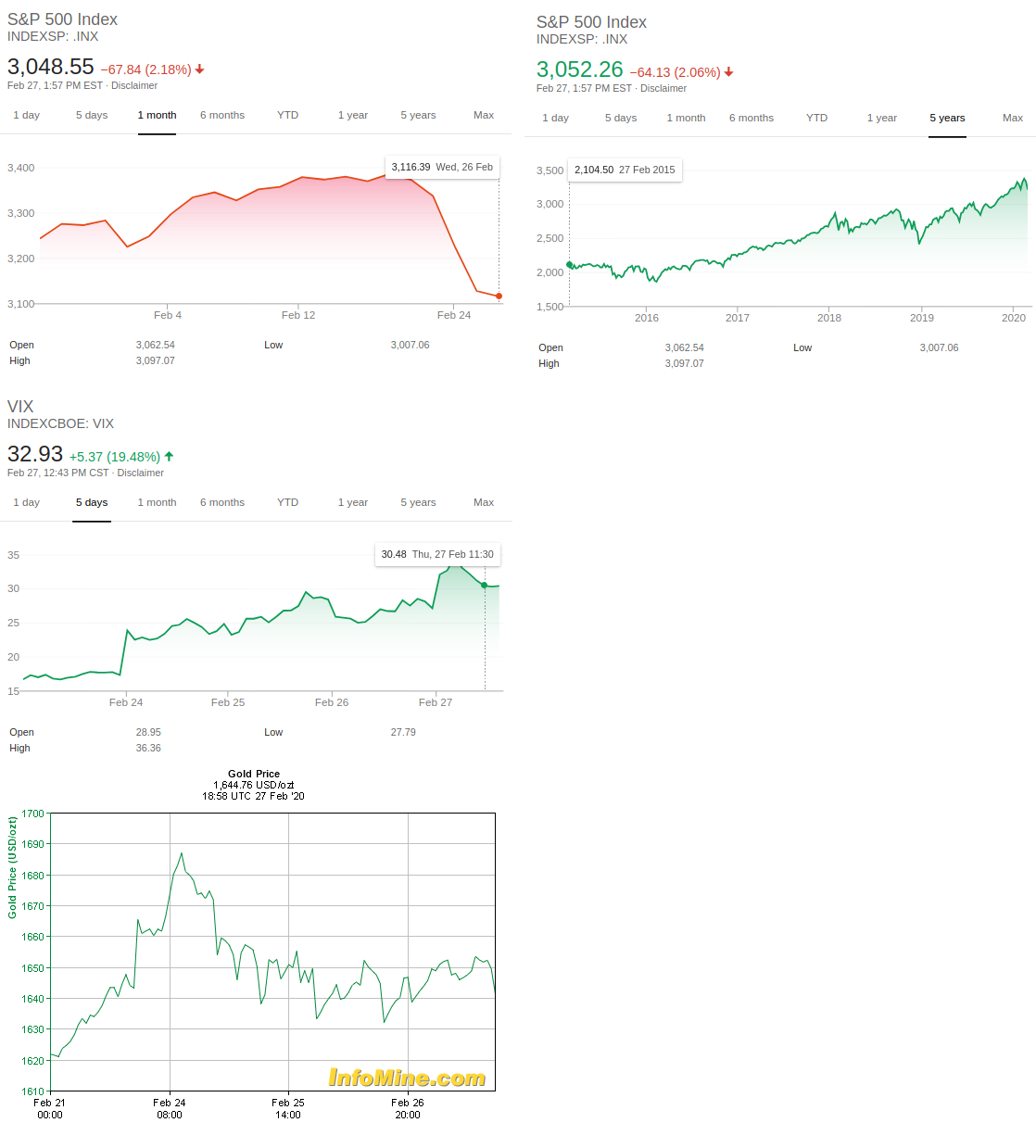
"Unfortunately they have Hong Kong exposure, they have Asia exposure," a very interesting phrase I heard about CPRI which is way down and otherwise would be a more appealing investment. For the past 5 or 10 years the concern for companies has been "How can I get into China? How can we expand in China?" but having assets in China is currently a liability for businesses.
For markets, the issue is uncertainty/doubt. The "problem" stops once the government convinces the public the problem is containable. The Fed can/will attenuate the spillover effects from confidence demand by altering rates," one economist noted, likening the situation to 911 where people wanted to be sure there wouldn't be another terrorist attack.
Volatility is very high, so investors are making money off of calls, setting their buy price and sell price as value jumps around.
From a watching perspective, the event is interesting. No one knows what is happening at the moment or what will happen in the future. They don't even know a little bit. The round tables of economists and stock market newscasters are divided and no one is offering any confident assertions. If anyone did they'd be lying or wrong. It's like the beginning of a drama, where things go wrong or badly from an initially good, basically stable-seeming position. For the economy that was a steady recovery for the past 10 years from a serious recession, the rise of a huge new market of China, and tons of money to invest in the past couple years with the massive stock market bull. That might have been it's own drama, but I don't know how interesting of one, just watching and benefiting from profits. It's a healthy, undisturbed environment where not much changes or challenges. Here we're seeing a vigour which accompanies these types of economic times, and it's apparent in everyone - the round tables, the economic scientist commentators, the investors themselves I think. Everyone is moving in the situation. Perhaps not going to work, because that's something that's prohibited by the virus in China at least. Japan is going to not open schools for a couple weeks. We don't understand the virus yet. It's novel. At some point, perhaps there will be a low point, a solution or solutions, heros, and a change and positive movement.
There have been 80,000 confirmed cases, and almost 3000 deaths. The following statistics I don't think should be taken as descriptive since our knowledge of the disease is really limited, and our access to real facts from countries is also really flawed and limited.
The death rate for Coronavirus is considered (for now) to be 2.3%, basically set by Chinese events which is where the majority of cases have been so far. The death rate for the flu in the US is 0.1%. Part of this difference must be due to it's novelty. No one has any immunity to this new virus. The basic reproduction number is between 2-3 right now.
The older a person is, and the more health issues they have (heart, lungs, diabetes), the more dangerous it is. "The [Chinese CDC] study showed that ... among those ages 80 and older, the death rate was 14.8%, compared with 8.0% for those ages 70 to 79; 3.6% for those ages 60 to 69; 1.3% for those ages 50 to 59; 0.4% for those ages 40 to 49, and 0.2% for those ages 10 to 39. No deaths have been reported among children from birth to age 9."
Some suspect children are only getting subclinic (asymptomatic) cases is that their immune system is not developed as much as adults', so whereas adults immune response is causing problems children aren't having that response.
According to later data, it seems men are much more likely to require treatment (70% men), and death (3% men, 1.5% women). Also that underweight people were less likely to get severe reactions to the disease (less than 1% of cases). Regular weight and overweight people were much more likely, where regular weight people were only slightly less likely than overweight and quite overweight people).
Later reports from England's chief medical officer stated that the total Case Fatality Rate would be around 1%, higher for older people.
Some experts expect most people everywhere will have/have had COVID before a year passes. They expect it will be the 5th type of virus that will just go around every year (there are like 200 types of "the cold," which I guess belong to 4 types or something).
Now, US doctors test for it, but initially they were encouraged to not test for it unless someone came from China.
Symptoms appear usually around 5 days after infection (2 days to 2 weeks being the range). It is a respiratory disease, beginning and ending in the lungs, passing between people through the air, like the flu, generally through coughing and sneezing. To fight the infection in the lungs, the body floods them with immune cells to clear and repair damage from the infection, but the problem starts when in some people this immune response goes awry and the immune cells start killing a bunch of regular cells, causing a buildup of debris, worsening pneumonia. People can die from this. Some people who survive it have permanent lung damage, having holes in their lungs (a similar thing happened with SARS infections) as the lungs scar (which both protects and stiffens lung tissue). Lungs can fill with fluid to the point people can't breathe, also, because inflammation makes the membranes between the air sacs and blood vessels more permeable, which can fill the lungs with fluid and affect their ability to oxygenate blood. The body's immune response can also cause problems in other parts besides just in the lungs.
Looking at our long-time companion the seasonal Influenza bug:
Flu is a respiratory illness, but it is also a gastrointestinal illness, and an illness of headache, malaise, myalgia, cough, sore throat, and rhinitis.
Incubates 1-3 days. Viral shedding 1 day before symptom onset and persists for 5-7 days after symptom onset, high communicability through large particle droplets, aerosol transmission, surfaces, half of people have limited or no symptoms (although they can transmit the bug). Onset of symptoms is abrupt, last 3-5 days, recovery often prolonged, sometimes can have complications like pneumonia (viral) and bacterial issues. Worse with cardiovascular, pulmonary or other health issues. Generally comes and leaves rapidly, in a few months of the winter in the north and south (what about tropical latitudes?). 5-20% of the population carries it during its visit. There is a high morbidity, including around 36,000 influenza-related deaths in the US's 330m population each year, with about 90% of those deaths occurring in people over 90 years of age. Economic toll about $90b in US per year, including 200,000 hospitalizations. The vast majority of infections of flu run their course and all is well.
Major dissemination of flu are children and health care workers. Usage of antivirals has caused influenza to become immune (resistant) to our antivirals. Some are now worthless, others (Tamiflu and Zanamivir) are still effective, but being used so much though that experts expect resistance will increase soon.
Back to Coronavirus now. A person is most contagious around the time of the first symptoms (first starts to feel ill), so if people first start to feel ill, then go to work because they want to see how it'll pan out or don't want to think about it just yet, that's when they'll be shedding the most virus. Less infectious after 7 (this is doubted and could be a bit longer) days. However, a recent study in the Lancet by Chinese doctors reported they found a max of 37 days for the virus remaining in the lungs, with a median 20 days (varies by severity with 24 day median for those with severe disease status), so quarantine periods might be extended when this information becomes distributed. Also, some of the people who have no symptoms or very mild symptoms (maybe just feeling a little bit ropey) can be highly infectious, and we don't understand this part of the virus.
From a person who recovered, he first had a cold, then the cold was subsiding, then he got a flu which was the worst flu he'd had, then he got pneumonia (he said you feel like only 20 percent of your lungs are working and you hear a crackle when you breathe).
It kills people through Acute Respiratory Distress (not enough air in the blood, because the lungs are inflamed and the air sacks are full of fluid ie pneumonia). People are put on ventilators to make sure there's oxygen in the lungs and to breathe for the patient.
To treat Pneumonia, doctors have found over the past 20 years that they have to ventilate with low Tidal Volume (so they don't put a lot of sheer stress on the air sacks but forcing them open and closed), by inducing paralysis so the patient doesn't try to breathe over the ventilator because they're uncomfortable with the low level of carbon dioxide), and by putting patients on their stomachs for 17-18 hours per day.
For lung infections, for the past decades doctors have treated them sitting up (not lying flat) as long as blood pressure can support it. Also, plenty of liquids under the supposition it keeps the lung mucus thin so it can be carried up the trachea by the cilia and expelled.
Update: last on surfaces for up to 3 days, particularly on warm surfaces. Feces and bodily fluids up to 5 days. Can linger in the air for 30 minutes. Later update they say hard surfaces up to 3 days, cardboard 3 hours, and that it doesn't do well on food. I don't think I buy that though, about not doing well on food. Also, a cruise ship had said it found active virus 17 days after contact with a surface.
The immune system relies on white blood cells. Vitamin C is thought by many people to help, and it isn't produced or stored by the body, but can be obtained from pills or from red bell peppers (lots of Vitamin C) grapefruit, oranges, tangerines, lemons, limes, and clementines. While there isn't any proof out there it seems, there are doctors and others who say it really helps. Yogurt (the ones with "live and active cultures" like Greek Yogourt, can stimulate your immune system, and it also has Vitamin D, which is scientifically proven to nurture the immune system. Vitamin E supplements, but E requires fat to be absorbed, and for that reason it's nice to get it from Almonds (a half cup per day), which have fat too.
Apparently (from a good amount of quality science) Vitamin D reduces likelihood of getting respiratory / respiratory tract infections (viral and bacterial) and can make infections less severe. It increases the immune response. Vitamin D comes from fatty foods (fishes, egg whites, cheese, beef liver, and its been added to some orange juices, soy milks, dairy products), but we get most of ours from skin exposure to the sun (faster produced in lighter skin). Adjusted odds ratio if taken daily/weekly: 0.81, ie a 19% protective effect overall, or put another way 19% less chest infections. Daily dosage for Vitamin D is 25mg (1000iu), with a safe upper limit of 100mg. Vitamin D can be overdone, as it's fat-soluble so the body stores it, and it can get to toxic levels. The best way to know the right amount is to get tested by your doctor, because many people are deficient in Vitamin D and require more than other people who aren't deficient.
People do better in warmer environments too, because the immune system is more active, as well as a bit more humidity.
Zinc in some studies showed to decrease the time of a cold by half. But the type of ZInc matters: Zinc Gluconate lozenges that provide 13mg of Zinc lessened the duration of colds while Zinc Acetate lozenges of 5-11mg did not. Excessive Zinc consumption can lead to copper deficiency and can impair the absorption of antibiotics.
Vitamin C hasn't been proven to help, except in some studies that weren't able to be replicated. Vitamin C isn't stored, but can cause stomach aches etc in some people when they consume a lot.
With coronaviruses, heat destabilizes them. A small amount of microwaving kills them. Cold they're OK with though, and some species can live up to 2 years frozen.
February 29 (Saturday) and the markets kept going down for the week. The only companies that are doing well have to do with predictions of a stay-at-home, work-at-home lifestyle, such as semiconductors (video games, computers), teleconferencing, watching tv, etc).
New cases everywhere, including a couple in the US, elderly people where they have no idea how they contracted Corona Virus because they seem to have had no contact with the existing budding pandemic. Cases reported in 50 of our around 195 countries.
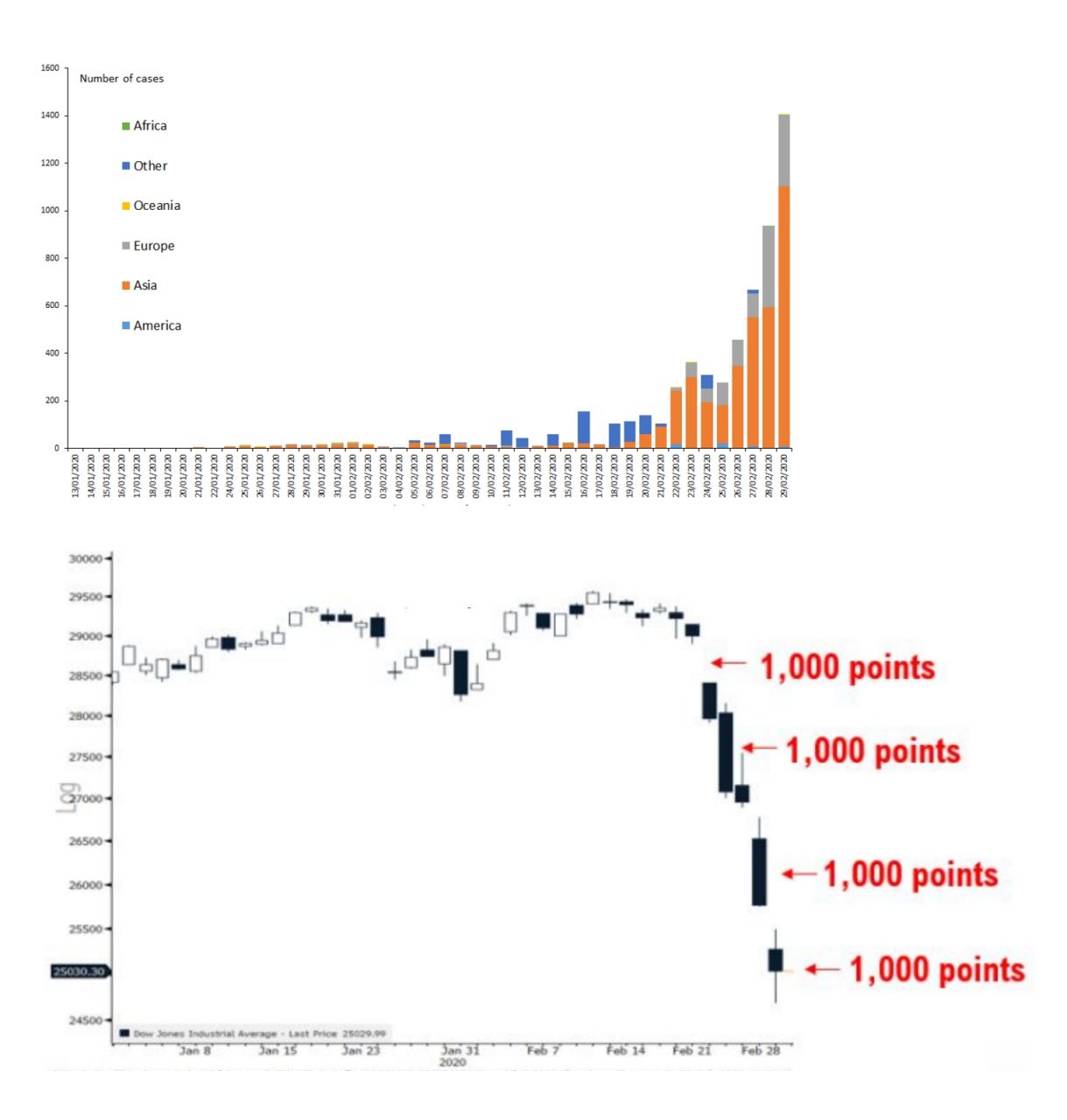
(Note: although point numbers are historically high, percentage of market value is much lower)
Countries continue to increase measures to inhibit the spread (travel restrictions, people in hazmat suits spraying public areas, cell phone apps that alert you when you enter areas with confirmed cases). US has done around 500 tests, and don't have test kits to really do more.
Will virologists and the study come to the fore this year? A longstanding project is the universal flu vaccine, which people say may come in 10 or in 50 years. How this study works is they take existing viruses (Spanish flu, avian flu) and allow/create mutations, to see how it might change in the wild by itself, then study those mutations and create vaccines. They also take non-human existing flus and study those and how they change and how they might be if they mutated to adapt to human hosts. This would be a benefit, because viruses are a serious risk to every person here, and its just a matter of time before the next serious one in the long historical string of them wraps around the world, like Spanish Flu did, killing 40m people in the first 18 months after it began and eventually affecting around 60% of people everywhere in period bouts over the next 30 or 40 years. Pandemic influenza gets forgotten completely (the Spanish Flu killed 675,000 Americans but left no trace on the national culture) and then "falls out of the sky" and the world is suddenly experiencing it, not just thinking about it, like it did in 1958 or 2009, depending on how old you are.
Viruses have huge potential for change (antigenetically, clinically, epidemiologically, antiviral or susceptibility). There is a huge immunologic pressure for them to change. This is what flu DOES. Potential for co-circulation with other flus. Potential for re-assortment (mixing and matching of components with other flus that have different age predilections and illness severities). The longer the flu is among us, the more chance there is of this occurring. (words of Dr Shult of UW School of Medicine). Vaccines can allow us to damp down succeeding waves of infection, but they can also force a disease to adapt/mutate more quickly.
Interspecies flus: The flu isn't very successful in passing from birds to people, but it passes from birds to swine and from people to swine more easily, so swine is a useful intermediary vessel between us and birds, and this is how we've gotten a few serious strains of flu recently. Another way is when the bugs have escaped from our virology labs to infect the public.
Comparison of Coronavirus with H1N1 (a novel subtype, to which the overall population had no immunity, of Influenza A virus) in 2009. The first cases of H1N1 were announced April 15 and a global pandemic was declared just over 2 months later. It was the first experience of a new, dangerous flu for basically everyone of working age. Response efforts increased dramatically, partly due to successful "flu surveillance" (reporting and monitoring of incidence, hospitalization, death, etc). The CDC and other organizations share a lot of information. There was no time to really prepare for much. H1N1 was controlled. H1N1 was very different from Coronavirus in that sick were obviously so, presenting symptoms in all cases.
With H1N1, children (usually hard hit) and young to middle age adults were particularly hard-hit. In Spanish Flu also it was young adults who were hard hit in terms of hospitalization and mortality. With seasonal influenza, usually the elderly suffer 90% of the mortality, as I mentioned already.
Stocks are considered to be priced above value. I've heard that over 90% of a stocks value is based on the company's profits over the next 12 months. That means that if stocks have dropped 10%, that should cover a consideration that there won't be profits for the next 12 months but then profits will return to normal. The stock market has been momentum-driven, and stock prices had gotten significantly above values based on potential profits. Some argue it's really the federal reserve that's been propping up asset prices. There have been many bulls and the market has been despised/hated by some. After the week of drops, economists are saying that prices had become reasonable. As long as the expectation, despite uncertainty, is that things will return to normal in 2021, the current events should be considered a "wobble," "a sell off," but something that doesn't destroy the fundamental values of equities. Economists compare it with the Lehman crisis, where afterwards credit was frozen for years and damaged the viability of the financial system as a whole. They say there might be a 20-30% drop at worst, for a year, compared with an 80-90% drop in the Financial Crisis.
Bitcoin and other crypto are also down, as is gold, for the week. They were for a long time thought to be safe havens, and over the past year have evinced that, like when Greece had problems, etc., because its money that's not in the bank. Gold was up in the first part of the week, but then dropped. Personally I suspect that's because people were early this week talking about a regular recession more, and I think it might have been actually catching hold of some people (including myself) that it was about time, and then a Coronavirus scare/dip, which then everyone hyped Coronavirus, as well as it actually becoming serious and widespread in reality too. Mid-week people were talking about the numbers showing China's cases were plateauing and not many new cases elsewhere. Coronavirus was small and known only in China for a month or two. Isolated cases on cruise ships and the odd country. Then numbers shot way up (in accordance, I suspect, with the transmission-incubation ratio of 2 or 3 to one, which is peanuts for the first couple multiplications but then becomes a dramatic explosion. Rich people were hoarding cash, I had heard. If things continue as they have started the past week, this is the smart strategy, as emotion drives investment in the current market (more than financial analysis and investment on such a basis), and currently there is a ton of doubt, a lot of negative outlooks, not really any reassurances or assurances. There is also some fear. Lineups and unavailability of face masks and the threat of unavailability of medication is a serious thing to see. Cash is only smart if everything else is going to not grow or is going to shrink, since cash of course loses 2% per year due to inflation. But cash on hand can be invested when low points come.
China: Swine flu, bird flu, now Coronavirus? During SARS China was 4% of the global economy, and its contribution to global growth was maybe 20%. Today China is 20% of the global economy and it accounts for half of global growth. Now globalization is deeper than then. Now China is key for global supply chains. All over the world, companies are shutting down because key supplies aren't coming out of China. Markets are expecting close to 6% growth of China's economy this year, but best case will be 4% and worst case 2.5%, according to some economists. Italy was already in recession, Germany close.
Markets plummeted dramatically in Brazil after news of one case. What happens when there are a few hundred in Germany? Perhaps the panic is in part to do with the denial by leaders. This reminds me of Ebola and the denial and dangerous downplaying. But if leaders had said "Prepare yourselves, this is what's going to happen. This is what we're going to do to create the best possible outcome. This is what you need to do, and this is what we are going to do for you (take care of supply and security needs)." panic would be less. But instead we get "Everything will be OK. It's not very serious," followed by conflicting reports of actual facts.
Monday, March 2 and the markets all went back up around 5%, the biggest bounce up or something. I sold my profitable stock this morning (when it was just a bit up, although it went up over 5% for the day) and am holding only stocks I've lost a lot on and don't want to sell at a loss, plus they do have a dividend.
Apparently Buffet's Berkshire is also hoarding a large stack of cash, I heard today, and recently explained it to his shareholders. He's holding 112b in cash plus 20b in bonds.
Tuesday, March 3 and the markets went back down again, about 2 or 3%. Most stocks went down. A few went up though, ones you might expect. Etsy is doing quite well (note: it shot way down the week after) and joined other stocks). The stock I sold yesterday morning and then went up went down today, losing most of the gains from yesterday. Losing stocks I held went down even more. Most gold stocks went up today.
It's thought of as a "true shock" in the sense it wasn't anticipated (and nothing was priced in) at the beginning of 2020 or even a month ago. Uncertainty is very high because we don't know yet much at all about the virus, it's severity, even if numbers aren't that scary right now. People watching stocks are thinking about supply chains and economic activity disruption, and also about demand effects from people not wanting to go to busy locations.
The US Fed cut rates 50 points (usually it's 25 apparently). Commenters now are saying it was a mistake, a sign of panic that won't fix the problem because the problem has to do with health and fear of going to public places, unlike 2008. Last week though commenters were some saying they wanted the cut, and I didn't really hear any saying they were opposed to it. At least one, though, said rate cuts would HELP, even if it doesn't FIX anything. Also a talking point is that the Fed doesn't have much room to go because rates are already so low.
March 6 (Friday). The markets went down again yesterday a few percent, and another percent today. Commenters and investors are uncertain and divided whether to say it's a blip or the beginning of a recession. I get the impression they're talking half to their investors when they're giving their opinions about what they're doing with the money they're holding in terms of investing, and seem happy whenever anyone makes a hopeful point. One made the point that it's a triumph for a diversified portfolio (50 percent stocks, 50 bonds) because these would be down about 2 percent from the beginning of the year. Which seems just silly to say.
I'm basically out of investing for the time being. I have no idea or any educated guesses other than that probably all markets and stocks will go down for a while, and that stocks that won't suffer from the Coronavirus (semiconductors, medicines, gold maybe) have shot way up during the past week and may be highly overvalued. I'll just stay liquid until some actual information is available.
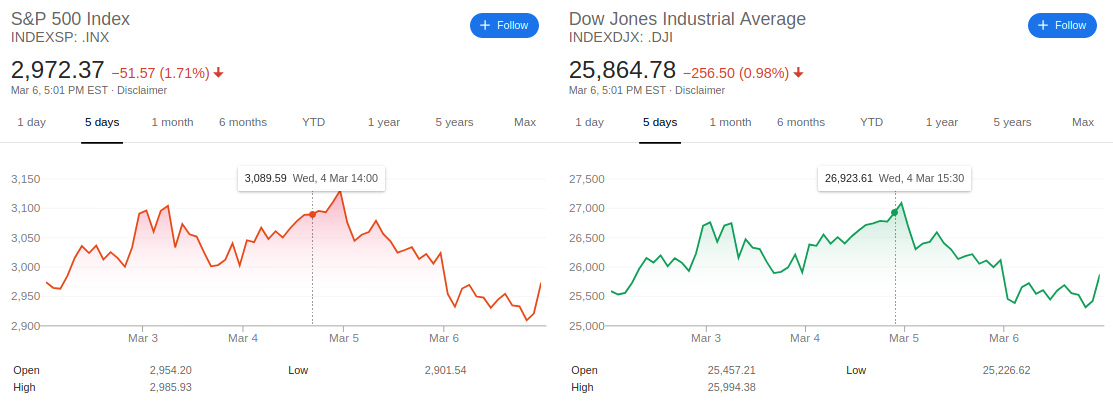
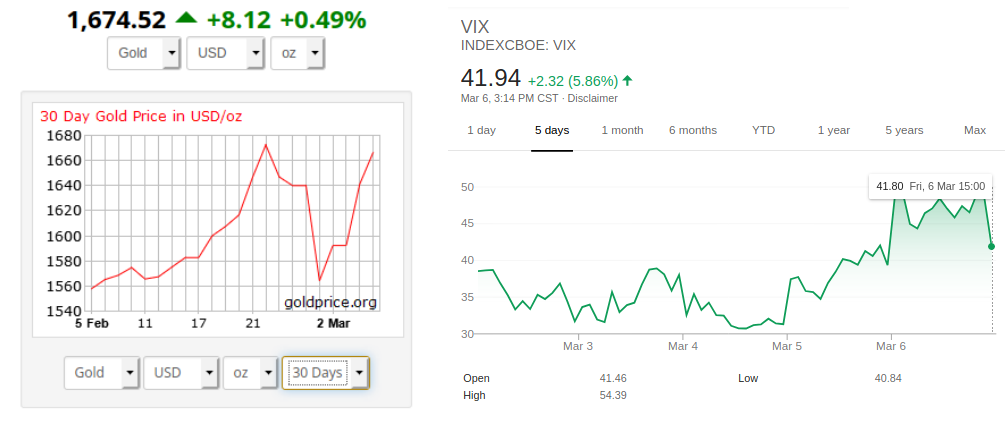
100,000 confirmed cases was reached yesterday (in actually, there would have been 100,000 cases a week or two ago). Several thousand deaths.
The Chinese people, all of society, have been mobilized in a fight against the virus, and their reported numbers have gone way down. Some doubt the veracity of these reports, others believe them, considering how China (and Korea) have taken the virus very seriously, locked down travel, confined people to their houses, done a lot of testing.
Theoretically, if for 10-14 days everyone cut off contact and stayed home, and if food was delivered and if there was a vehicle driving around with test kits for anyone who called them, the virus would be contained and ended (not counting possible animal infections).
The US and Europe have shown, people say, are taking it more lightly, even thinking they won't get it (a Korean was quoted "You have to experience it personally to be able to understand."). Educated people in those same countries believe they'll get it themselves in a couple weeks, and that 60-80% of people everywhere will get it, and it will now be with us perpetually, and for this reason a virus made soon would be best (soon means 18 months to 2 years). The US government is starting to use "social distancing" to talk about how people should start behaving. "workplace continuity" is the tradeoff, with businesses trying to find ways to keep going. Some strategies include 2 shifts of workers who never meet and working from home.
An interesting point raised by an expert: That the young and generally healthy won't perceive personal risk and will govern their behaviour accordingly, based on personal risk and not on social risk.
South Africa has 7m (20% of the population) has HIV, some using strong suppressants and some not. We don't know how they will be affected.
Jeffrey Gundlach has also said staying in cash is better than 10 year bonds, because the rate with bonds has gone down to the point you won't make any money with them (you just won't lose money through inflation). He advocated gold, which is what I started moving on today in terms of how to get it. Crypto is another cash / investment alternative, and although it sometimes goes up, sometimes down, during economic uncertainty, I think there's at least a decent chance it will become more used, and a decent chance it will be valuable if ever cash became severely disvalued (like Venezuela, which now uses USD).
For a recession, he said he looked to the unemployment rate, which is almost definitional of recession, and also reflects consumer confidence (which has been very resilient and very high recently, although more recently the view of 12 or 18 months into the future has been dismal). That when the view of the present joins the view of the future in weakening that is also sort of definitional of a recession. Jolts figures (employment) have been very weak which may forshadow an uptick in employment.
The two falling knives, he said, are financials, which are being trashed by interest rates (low interest rates and low tenure rates banks can't make any money), and transport, which I've already written about above.
As to negative interest rates (a complete disaster for the financial system in whatever country does it, such as already has done Japan and Europe, which hasn't been catastrophic because rates remained in the US), talked about a lot among investment commenters, Jay Powell has said repeatedly that he favors doing large-scale asset purchases to negative interest rates. Quantitative easing.
Monday, March 9, the markets dropped around 7 percent. Saw a few headlines about the prices having priced in now a recession.
China has reported under 50 new cases in Wuhan on the latest update, no new cases outside of Hubei Province except 3 backflow cases. WHO says so too. We're really seeing the contrast of different political systems this year. Usually we just see how terrible China is, but now we're seeing it's still terrible (massive fullscale monitoring and information about everyone with no choice to opt out, and human rights seemingly a foreign idea) but good as well, as they've used their social monitoring tools to stop movement and association. People comment regularly that that may not be possible in the US or other Western countries, but from what I've seen what has worked in China hasn't been just the abusive state control, but technology and will. The will to impose restrictions on movement, and use of technology to guide people in doing it. They built a SEPARATE hospital in 10 days for infections from the novel virus, and were building a bigger one I think that would take a bit longer. They offer apps that tell where confirmed cases are, and where those people have travelled (a bit of use of monitoring data here). They use drones to scold people who go outside and do unsafe things like not wear masks or associate with others. Any country, even one that respects human rights, could do these things and contain a social virus in about a week if they wanted to.
People who have recovered could be the ones to immediately fill jobs in doing deliveries, testing, and other interpersonal communication and services.
Yesterday Italy (the most affected of Europe, with thousands of cases, which Germany and France now have over 1000 cases each) imposed strict measures.
In market commenting, rhetoric has changed in the past weeks, it seems to me, from more of the same (for years) general lazy optimism because everything's going up still anyway, to excitement but debating whether it's a blip, and investors saying they're going to buy / hold still, to now full on talk of recession, criticizing past government moves, etc.
Talk of how the lower the markets go, the less stocks are worth because of sell-off, the more people have to sell off. I'm not sure if I buy that, because I don't really understand for sure what they mean.
Talk of the 2020's economy: deglobalization, which to me I don't know but might be good. I was generally strongly against and believed against globalization since it started, and I'm not sure I've seen anything to change my mind in the last 15 years. Deglobalization will be a focus on countries that don't need other countries, cheap countries, oil-IMPORTING countries (because the oil price keeps settling lower). All the world economies are now well on their way to slowdown and stopping (China finally, Germany, etc).
Yen is up. It's been said the USD will go up against other currencies, and the Yen against the US dollar. (The funding currencies.)
Last week Russian and SA had some kind of falling out over oil, a price war, and SA said they were going to increase production (we already have shrunken demand). Might be oil companies closing soon. 10m jobs in the US fracking industry, oil has fallen to pretty much their cost of production ($32.5 per barrel today). Prices dropped 33%, their biggest drop since the Gulf War (29 years ago). Russia, with it's $7 per barrel oil (SA is $3 per barrel), no debt (SA does have debt), and their gold stores (they've been buying gold), very well positioned to go into a very long oil market battle, thinks they can thrive and put some competitors out of business (just when the US reached energy independence). Creates stress in US market and emerging markets. Others say most US companies will be OK until around $26 (a previous low), while less successful/good US companies will fail or sell their best assets to bigger companies (ie bigger companies could thrive in part). Commenters say that's good, though, because it's needed to be done for a long time. They have a lot of debt, and there are about 50 companies in the US supplying oil, and their costs are around $55 per barrel overall, whereas if you take out the smaller, more indebted (paying it off I guess) companies, average cost goes to $45 per barrel. Commenters think that the US shale market will need a massive government bailout but still won't survive.
SA announced it's production for April will be 12.3m barrels per day (an extra 2m barrels per day). Commenters say that means there's potential for a $20 barrel of oil in the coming months.
Theoretically, Russia could last longer because the Russian fiscal break even is $45 per barrel while the SA is $90, although both have stockpiled about a half trillion dollars. Russia has for the last few years stockpiled that amount in its sovereign wealth fund reserves, foreign reserves and gold reserves.
New age energy producers (windmills, solar energy, Tesla) just became much less competitive, and won't be able to compete, say commentators, meaning the fossil fuel industry might be even better positioned in a year.
I think investors, who have been in what has basically been a passive investment mode in the stock markets for the last few years, have made great returns since 2008, and had a few huge periods over the past couple years. Basically buying every dip and watching the stock rebound. Probably they are saying well I made a lot, I can take it out now. They're thinking I want to go back in when stocks hit rock bottom, and watch values rise again.
Because of the passive investing in the stock market thing, combined with cut rates by the Fed, volatility is crazy right now.
I suspect it's largely an emotional, uneducated investment body (excepting some real value investors who have been complaining recently about how overvalued the stocks are and keep rising, being "valued" at way past their value based on future profits. Emotional going up, emotional going down.
BP PLC dividend: 9.71%. Exxon Mobil div: 8.22%. Chevron div: 6.20%. Again Capital founding partner John Kilduff said by his math they should be able to keep paying even these lofty dividends, based on his math on some of the machinations Exxon and Chevron have been doing lately and if they stop doing buybacks.
Tuesday Brent went up to $38 today (up 13 percent).
Talk of Chloroquine (older Malaria treatment) with Zinc treatment that has been used in Korea (other option is an HIV disease). Zinc if it gets inside the cell can shut down viral infections of those cells (Zinc shuts down RNA-dependent RNA polymerase, blocking viral replication inside of the cells), but Zinc can't get through the cell wall (Chloroquine somehow opens up the ion gate to let Zinc through).
Medical bloggers are talking about Korea, who have very few new cases. They compare Korea with Italy, which has similar infection numbers but an order of magnitude more deaths. Two things: one is that Italy's known/recorded number is just the tip of a much bigger iceberg. Other one is that Korea's testing (they've done around 200,000 tests, so their number of cases at around 7,500 might actually be the actual number of infections) has helped. Korea is actively going out and looking for people to test, and they do a lot of testing (as much per day as the US has done period).
Wednesday, March 11. Leadership wasn't there in China at first (coverup, downplay), but later was there strongly, and with leadership and enforcement effort their cases are way down. Korea also. Italy just recently took strong measures. Commenters have noted that in epidemics and outbreaks leadership makes a big difference. When you have no vaccine and no proven cure, you rely on public trust. Understanding, trust, cooperation, and it has to be what's appropriate for a place at a particular setting.
Times (after WWII began, Polio epidemic of the 50s) of collective national sacrifice. Everybody is in it together. Everyone is at risk. A time of terror. A time when the pandemic fear gets going, people who went into it thinking they were going to be good soldiers and help people, stop seeing each other, they stop caring about each other, stop volunteering. People ashamed of how they behaved. Hospitals overwhelmed. People screaming and crying.
Governments in other countries (Italy) are looking to China as a model for how to handle the outbreak. To have the numbers stop increasing.
It's crazy. A coordinated effort of just 2 weeks could basically stall the virus, but no one wants to do that, and countries funnily don't seem to be prepared with ways to handle any type of emergency.
Markets, gold, and Brent down.
Bitcoin down almost 30%. Speculative/alternative asset like gold, but more volatile. People want cash. People are looking around and saying what can I sell? "Cut all your positions." High risk assets in a volatile market. With less liquidity, high yield, there's no bid.
Korea had another set of cases at a factory. I think about 100 people.
Thursday, March 12. Medellin had a fourth test positive last night. The first was about a week ago I think, a women in her 50's who returned from Spain. Colombia has a handful of positive test cases in about 4 large cities. It has since closed international flights, and when people can enter on a flight they must self-quarantine for 14 days in their house or hotel. Funny if they had done the same thing a week or two earlier, they would probably not have any cases in the country.
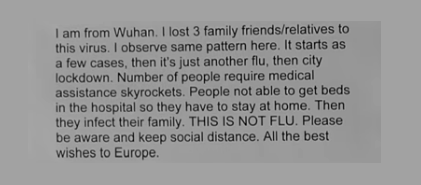
A letter from a Chinese to a European medical vlogger:
It seems the WHO's delay of declaring Coronavirus a "pandemic" is that there is now community spread in many countries around the world.
$9 trillion of world's economy is travel and travel-related. If 50 or 60% goes away in the market for 2 quarters, that's 5% of world GDP.
Stock markets went down 10% today, triggering the stop (it triggers a market pause of 15 minutes). Gold and Brent also down, Brent to $33.
US closed air travel from Europe. All sporting events are cancelled. Disneyland closed, and Disney postponed releases of it's new theater movies.
At this point there are three examples to look at. China acted within weeks in a completely repressive and authoritarian way, and it worked (directionally under control). South Korea acted in a very different way but with aggressive broad-based testing, and it worked. Italy recently acted with a broad-based federally instituted top-down shutdown of everything, and we don't know yet if that works.
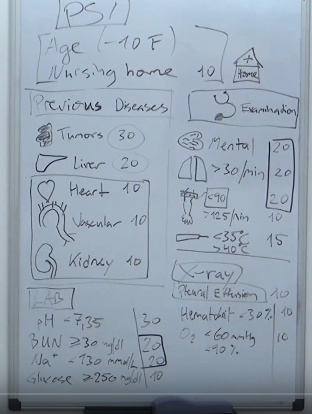
Assessing pneumonia chart:
Stages of an outbreak:
-Containment: This includes testing to find out who has it, to isolate them and try to keep the infection from the general public. This stage may not contain the virus but may still be useful, may buy time, provide information, etc.
-Delay: Institute social distancing to delay numbers and push the epidemic peak back and reduce the peak high so the health system is less overburdened, to build more health system capacity, and to control when the peak happens (avoiding winter sometimes when people already have chronic pulmonary disease obstruction exacerbation as in winter months, plus winter influenza, plus lowering the peak means less people will be off work and society can continue to function normally). It includes masks, washing hands, not gathering together and socializing, etc. At this point or later, there's less point testing people at random because we know the community has and is passing around the disease. After "containment" has passed you call for medical assistance if you feel you are deteriorating. The test is used as an aid to clinical decision-making at this point. Travel history is also at the "delay" phase irrelevant, which might explain why US airports don't do much or even question about Coronavirus when people arrive from anywhere.
-Research and Treatment: Including a vaccine and what treatments might benefit someone who's affected
-Mitigation: Making complications less damaging, such as low levels of oxygen and secondary bacterial infection
Things countries did well:
China, once it took the virus seriously, built rapidly separate health centers JUST FOR the novel virus. Hospitals are locations regular people obviously need, and treating Coronavirus there exposes the vulnerable (20% of healthcare workers in Lombardy, Italy (the country's epicentre) have been infected), the community, and healthcare workers to the disease. A separate location isolates a novel and still-developing virus. Specific special precautions, tools, and isolation architecture can be implemented (negative pressure ventilation, masks, isolated rooms that don't have much medical equipment, ventilator rooms). China built it's centers away from town on an existing transport highway. It's easy to get to and far from everything else. They also flew in 50,000 health care workers from other places. (Compare with video footage of Italy's overburdened advanced health care system general hospitals and 20% infection rate of health care workers in Lombardy).
China, President went on TV and declared war against the virus and led the people in taking it very seriously and everyone doing their part and not being irresponsible.
China, used drones to move around the streets to scold people who were out of doors without masks or congregating with other people,
China, used an app to notify people of the danger/safety of locations they travel to.
Korea, daily livestreamed community briefings by the US base there's garrison and installation commanders, with questions and answers, as well as multiple virtual town halls with their senior commanders.
Korea, immediately set about seriously manufacturing and using tests, testing aggressively and broadly. They have drive-through tests. You drive into a parking lot in your car, they test you through the window, it's free and takes 10 minutes, and you get results in 2-3 days. "You must find these people quickly. And you must not be frugal about the costs. It's the State's basic duty to support the lives of it's people," said one Korean mayor.
Italy, shut down country and closed international travel (although if it had done so sooner it could have contained the spread or at least limited it).
However, a Chinese official recently stated that the consensus among health care professionals seems to be that travel bans are not effective in containing contagious illnesses, and can make things worse by fuelling a sense of complacency."
El Salvador, with no confirmed cases and despite bordering three other countries, El Salvador placed the country under quarantine March 11, which would last 21 days, with schools closed and large gatherings prohibited. “How much would Italy give to be in our position and be able to declare a quarantine before having thousands of cases," said the president in his address. All foreign travel into El Salvador is banned (except residents and diplomats and nationals, who will be isolated for 30 days). “I know this will be criticized, but let’s put ourselves in Italy’s shoes. Italy wishes they could’ve done this before. Our health system is not at Italy’s level. It’s not at South Korea’s level," said the president.
“Why would a country declare quarantine without any confirmed cases?” asked epidemiologist Gerardo Chowell-Puente, chair of the department of population health sciences at Georgia State University. He wondered whether Salvadoran authorities had seen factors that indicate trouble ahead. “It gives the impression they are seeing a surge in hospitalizations and that may be overwhelming the system. I don’t think someone would declare a quarantine suddenly without evidence of a substantial outbreak.”
But in the president's speech that week he said, “And not because it hasn’t been detected. The necessary tests have been conducted and they’ve been negative.” The government did have 56 people under quarantine at the time.
“He feels free to take tough-looking measures, which are often troubling to civil libertarians,” said Geoff Thale, president of the Washington Office on Latin America. “And he takes steps, like closing schools for three weeks, which aren’t necessarily the most appropriate measures in a country without any confirmed cases.” Thale said the measures could be the president’s way of appearing “proactive and forceful” but could add to the impression “he’s willing to take pretty authoritarian steps. He’s gambling on what this will do to his international image. And this may have more to do with that than with whether health authorities would recommend these steps.” - as reported by The Washington Post
Part of the reason Korea did so well as they had coincidentally just performed a national exercise in virus management (I think in December).
Friday, March 13.
The USA is taking a lot of criticism because it isn't responding to Coronavirus (finally only closed international flights from Europe only, has done only 11,000 tests when Korea has been doing 20,000 per day, and today announced more recoveries than new infections for the first time), and now expects very broad infection. However, I don't know how the US could contain the virus with it's combination of travellers from China, Korea, Italy and other countries that had already entered, and it's unprotected border with Mexico (Mexico is recording cases as "influenza.") (along with perhaps their social science advisors understand what possibly could be (I don't believe it is, even if it's beyond the ability or will of most people/leaders) an impossible task of causing Americans to respond seriously to the virus, even if the government did). The same goes for Canada. Although this doesn't excuse the Canadian leader's lack of seriousness or care for the population, they share a border with an America which isn't trying to contain or even really limit the virus it seems. The US keeps promising tests will come in the week and not delivering. Also, the USA is a bigger location than Korea, where it is easier to distribute tests, which doesn't excuse the supposedly most powerful country. The USA and other Western countries seem very weak in terms of health response ability compared with the Asian countries we've seen (China, Korea, North Korea, Japan), and if it ever got into a war a health attack would be potent against the West (which may have been what happened, according to some conspiracy theorists). In the US (I read a message board on this), people over 60 are largely laughing it off, continuing to go to casinos, not withdrawing from public, meeting in dollar stores talking loudly about how unafraid of the virus they are, proudly going to amusement parks and concerts with work groups, saying "if it's my time ..." etc., even with existing health conditions, and their younger relatives are worried about them but they won't listen. The other reason the US may not be doing testing is that once a country enters the "delay" phase, they know the virus is there and they don't need to go around and test you each time you call them, and they probably knew the extent of the spread already and that it was past "containment." Similar reasons for not screening incoming arrivals, as I wrote above.
Italy is also been kicked around for it's poor handling of the virus. However, it was the first and hardest hit. And other countries, even with the benefit of having viewed Italy, don't seem to be taking any more serious measures.
Chinese billionaire Jack Ma donated 1m masks to South Korea, Japan, Italy and Iran, and 500,000 diagnostic kits to the USA. Chinese doctors arrived in Italy to help there, with their experience with the virus. Actually, it seems it was a group from China, the Chinese Red Cross, 31 tons of lung fans, respirators, monitors, tens of thousands of suits and masks.
70,000 people have now recovered from Coronavirus around the world.
People are getting into trouble for selling fake Coronavirus cures.
Markets went up late in the day about 9%, 7% 25 minutes before the close during a press conference by Trump announcing a federal emergency declaration (which frees up $10s of millions in federal aid and unleashes some regulatory red tape for doctors etc.) in which he took a "CEO-focused" approach, referencing CEOs of Target, Walgreens, Google, taking a more serious approach than the downplaying he's been doing up till now (saying he might do some minor things, and do thing if he HAD to do them), and that the US government would take measures to mitigate the Coronavirus impact. Individual stocks basically all went up similarly significantly, between 4 and 11%. For the day, gold stocks went down, as did the price of gold, down 4%. Oil went up 7% to $35 The VIX calmed down for the first time in a while, although its still very high compared to previous to the last couple weeks. Although the market went up, it still doesn't look like there is a bottom because there doesn't seem to be a base of people who want to enter the market. There is more people who want to get out. The bounce might have allowed more people to get out. Because there is almost no liquidity in the market, you get massive moves up and down. Some of the biggest up days in history were during bear markets, like 08 and 09. Bitcoin also bounced up along with everything else, from $4800 to $5600 (was $8000 two days ago).
People talked about the 25 minute 7% being "there's something wrong here" but I suspect it might have to do with people/investors watching for a bottom (who maybe don't have much information on the virus and think the outcome will be much shorter term) and once some people started buying, many jumped in thinking it was going to shoot up suddenly (which it did for the day).
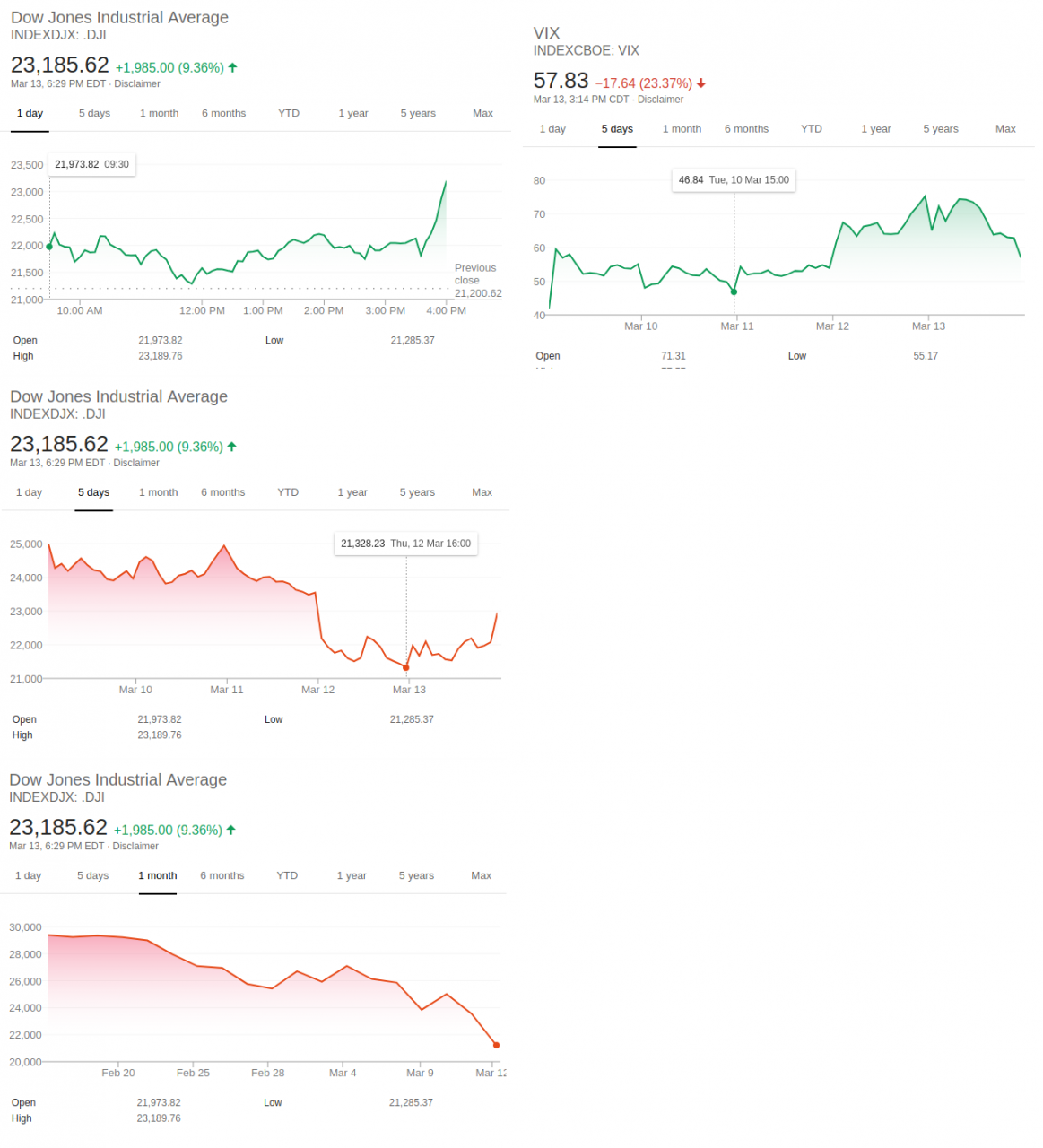
A question economists are asking is after the global recession, when the economy restarts, how is it gonna restart? When we get taken out of our comfort zone, we become more risk averse. Some say it will be about the critical mass, circuit breaker, having faith in the plans of policy makers (a plan of stage 1, stage 2, stage 3).
The bond market closed at 1%, record volatility. A historic move, and the bond move is telling us something awful, commenters think.
We don't know where credit is right now.
Corporations are taking out their entire lines of credit, like Boeing did yesterday. Bringing the cash in house, in case you need it as there is a sales and cashflow squeeze in an economic slowdown. As equity prices draw down, companies become less credit worthy. Uncertainty about whether a company will be able to pay its short-term debts. What if firms that rely on short-term borrowing in order to meet their many cash needs, are able to continue because the good they need delivered them can't be delivered to them cause the firm that makes them can't. There's a lot of debt in the system.
Economists are monitoring whether the shock will flow into the CREDIT system, or whether it will have a second order impact of creating credit problems. If it does flow through the credit system, they're thinking about two sides of it. One side is that never before have central banks been more plugged in to provide liquidity where its needed anywhere in the world. This is an ecosystem created by the problems of the 08 09 Financial Crisis. On the other side, there are high levels of debt and interest rates are low and there is a lot of liquidity already, so the impact of monetary policy is limited in its ability to offset a major shock.
The key to the virus is quarantine in our homes, say many. Countries shutting down.
John Chambers (former Cisco CEO who went through 5 economic crises and 5 health crises in his time) gave some advice on how corporations should weather the storm. 1)Don't hide, be very transparent, say what you know and what you don't know. 2)Outline what you're going to do, how much of the thing was internal-inflicted and how much was an external issue. Give your 3-5-7 action plans, whether you're a small company or a country. 3)Paint the picture for what you'll look like a year from now and two years ago. 4)Be open with all constituencies/stakeholders and give them regular quarterly updates, and make one move/change at a time and move on it aggressively.
In 1997, during the Asian Financial Crisis, everyone was pulling out of Asia and his company doubled down there, and a year later they had number one market share. In 2001 they got surprised, outlined a plan in 51 days, in day 52 gained market share.
He also said that problems usually will last longer than you think and be deeper than you think, and is thinking 3-5 quarters for the current issue.
The UK MP make an announcement the virus had a hold and he thought it would get worse, and they were moving to a "limiting stage" as I wrote about above. If someone feels ill they should self quarantine at home for 7 days. The issue apparent to them is that there will not be enough beds.
The WHO has said Europe is the new epicentre of the pandemic. China had 8 new cases and in Europe it's doubling every 4 or 5 days.
Without city lockdown and containment efforts it's thought there would now be 67 times the amount of infected that there was when they stopped doing coverup and the government took the issue seriously. There are 80,000 cases, up about 10,000 or more since they took it seriously, and now there are 115,000. It's guessed that otherwise it would be 115,000 x 67 = 7.7m. It's also guessed if China had acted 3 weeks earlier (no coverup) there would be 95% less cases.
People everywhere seem to be looking for leadership and a concrete plan that they can coordinate with everyone else through. Usually we don't want or need the government in our lives or businesses. Since governments impose so much, and harm people so much through this, we develop strong opposition and despise governments and resist anything they do. When we actually need leadership, perhaps they can't provide what people want/need and people don't want to receive it.
The uselessness or maliciousness of the WHO, with all their medical expertise and access to information, was shown in this pandemic. Those countries who followed along with WHO recommendations are highly infected. Only those who did the unpopular thing and closed off borders earlier have no cases. Any country that references the WHO in justifying or giving reasons for it's actions in the future must be idiots. Later on, the WHO (now advocating quarantine) is criticizing countries that "aren't doing enough."
Saturday, March 13 Guatemala had it's first confirmed case, a man who returned from Italy just a few days earlier. If they had closed their flights a week ago, probably not have any cases. All the president there did was expand the travel ban to Canada and the US.
"I feel a bit frustrated this month, but Ive become so much more aware of how precious our outside world is." - Wuhan 6 weeks into the pandemic quarantine.
After two months, they think, they will have quarantine measures lifted and can move around inside the community if the whole community has no symptoms for 14 days. They log into WeChat and get a health code (Health Code Online) and report if they have or still don't have symptoms.
They don't know how serious their neighbours will be about it, but it is warned that if a community hides any cases it will be punished. If they stay healthy the community will be rewarded with money.
El Salvador has no confirmed cases. Haiti also has no confirmed cases, but hasn't imposed strong measures.
Companies and bankers are meeting with private equity firms that don't usually lend to companies ("shadow leaders / shadow banking system"). Half the market vanishes in a pinch, and people want to shore up their liquidity. Corporate officials are rattled and want to make sure they have cash on hand to outlast the downturn.
Gold down 4%, Brent at $34 (Im not sure if my last couple days were right for Brent, it looks like the page I was using wasn't changing with reloading it). Bitcoin around the same.
According to Western news, a Chinese tycoon who criticized Xi's response to Coronavirus vanished.
Kijiji banned listings for toilet paper, hand sanitizer, face masks, and other items. People have been driving trucks up to large retailers and filling them with these items and selling them online for markups. Other people are stocking up bigtime.
Coronavirus is a scientific challenge and a social challenge. It could be either or both. In it's frame, countries are appearing great or poor in their ability to deal with it. Currently, countries are praising South Korea for its handling, China for buying other countries time, criticizing Italy and the US.
Possible the reason people seem so unconcerned and lassais-fair about the outbreak in China was that the past several serious disease outbreaks (over the past 20 years, several serious Influenzas, Ebola, and Zika), although threatening, were contained and didn't threaten most people, and people probably are accustomed to this outcome to the point they don't feel threatened by new viruses.
Continued as (PART II) : http://tttthis.com/edit/blog/talk-of-recession-and-coronavirus-2020-part-ii
Most recent (PART III): http://tttthis.com/edit/blog/talk-of-recession-and-coronavirus-2020-part-iii
Watch:
When people stop hoarding. When people stop worrying about having enough.
Related reading:
https://www.theatlantic.com/health/archive/2020/02/covid-vaccine/607000/
https://www.livescience.com/new-china-coronavirus-faq.html
https://www.nationalgeographic.com/science/2020/02/here-is-what-coronavirus-does-to-the-body/
https://www.mayoclinic.org/diseases-conditions/coronavirus/diagnosis-treatment/drc-20479976
https://www.youtube.com/user/Campbellteaching/videos
https://www.youtube.com/watch?v=vM8xVHP6Dgg&list=WL&index=7
https://www.washingtonpost.com/world/the_americas/el-salvador-nayib-bukele-coronavirus-quarantine/2020/03/12/d920e9a4-6404-11ea-8a8e-5c5336b32760_story.html and https://www.bloomberg.com/news/articles/2020-03-11/nation-with-no-coronavirus-bans-visitors-and-quarantines-locals
Assange is in a couple of news documentaries recently on YouTube.
He's now an old, weaker man who has been treated pretty bad for about 7 years.
He's from a period of time when there were a few people doing similar things, from similar motivations, standing up and really challenging world powers and governments. From what we saw, the majority of people aren't informed about these figures, couldn't understand them very readily if they were informed, and don't care. The minority who were along for the ride and watched these figures closely, I think some of them remained hardline supporters, since no actual evidence about their characters has come up despite a ton of character assassination. And others probably came to the conclusion that there's no point, not because they don't believe in human rights and not doing shitty things like those governments were doing, but that the people they sacrifice for are not worth sacrificing for, even though they wish they were. What's the point?
But after I watched the documentary, I scrolled down the page, and every - literally EVERY - comment was in support of Assange, what he did, against the government(s) for what they did then, did since then, and were doing now, and there were a LOT of comments. I was surprised by this. I was expecting to see a lot of comments against Assange or his character, but there weren't any, at least in the top several dozen I read. Can't fool them, despite all the work they've done against Assange, I guess.
Monday, March 16 the markets went down about 10% in the morning, then they were up a couple hours later to only down 7 or 8% I think, but closed just under 13% down, the biggest drop since 1987. Gold went down less than a percent. Brent went 15% down under $30. Bitcoin down, I'm not sure how much. The VIX was up 43% at 83. Gold stocks a lot were up, some up a lot. Some stocks went up. It wasn't like most of the big down days in the stock market where all stocks were down except really only a few. Village Farmers Market and Sprouts Farmers Market, for example, were up 12 and 5%.
There seems to be a kind of competition for which country will develop the vaccine. There's news headlines the US government tried to buy a vaccine or something from Germany to have total control over it. I haven't really read it yet so can't comment except people are talking about it and Germany later issued a response it wasn't for sale in that way.
The FED cut rates to 0. Analysts thought he would not do that. Jay Powell has said he didn't want to do that but would instead go with quantitative easing, as I mentioned quite a bit above.
This city has I think 9 cases, the country about 50. That's confirmed so maybe 500 total, and 100 in this city. I've started to buy groceries and put them in my apartment. And cleaning products. I'm going to look into what antibiotics and anti-inflammatories to get, and keep getting stuff each day. I'm downtown, and don't know this city very well or have great connections or a vehicle. Most people downtown probably don't have a vehicle though. Stores are just now starting to sell out of a couple things. Maybe next week they will be in the sad state we see other countries stores in.
I'm just coming off a regular flu. My chest hurts a bit today, I think the last stage. I'm thinking a lot I'd like to pass this flu before getting exposed to Coronavirus. Although I understand your body is weak for a while after you recover from the flu. I'm not sure if your immune system is ready to go right after or it takes time as well.
I asked a few people about properties outside of town, but no one knows anyone, neither did they know about apartments when I was searching for one a couple months ago.
The borders are closed to incoming I think, and citizens etc who enter must self-quarantine. That's the same in my own country, where there are more confirmed cases, and where stores are already selling out of most stuff.
France and most EU nations closed their borders for 30 days. Around 100m people are locked down in Europe.
Airlines had negative bookings (more cancellations than new bookings).
The US now has some drive-through test centers, and is going to do more testing I heard.
We still don't understand the fatality rate. France looks like 2%, Spain 3%, UK 2.5% (although that's only of detected tests), Italy over 6% (1400 deaths). In Europe, there are around 3 doctors per 1000. The UK has 5000 ventillators, and the government has called for more and said all will be bought, and things have gone into a wartime footing to switch production from whatever factories are making to ventillators.
Over 70s are to self-isolate (maybe for 4 months) in the UK and I think in Canada.
It looks like people hadn't been catching Coronavirus twice, which was something people were looking at, and people just hadn't cleared the virus the first time.
Countries (Austria, which has de facto quarantined the Tyrol region, and Romania) are enforcing non-movement with police and fines. Police will break up groups. They won't engage you if you're alone. Restaurants are closed. People who come from other countries and are under the 14-day quarantine will be checked in periodically by police and if they're not there they are fined and get a criminal file.
In times like this, opposite to regular times, I think there's a strong desire for a strong, forceful controlling presence and enforcement of quarantine, such as police to keep people from doing risky-to-public-health things. Also for the government to provide and increase health facilities and the necessary health equipment (manufacture). These police enforcement measures (police checking in on self-quarantine people) may even be referred to as 'draconian' but I write right now that it's welcome and bears a sense of relief to hear that type of action is taking place. It's not like regular times at all. However, the line must be drawn at crossing the line into human rights violations in terms of privacy, expression ie tracking, recording. Also, time like these when the people are concerned about health they couldn't care less about abusive laws that can be passed in the political halls of justice. So probably in a fair and just State these types of things (passing of non-essential laws and laws not related to the matter at hand (exclusively ie no mixed in laws) should be postponed to a more relaxed time. So what would meet my feelings ideally from a government would be to be quite totalitarian and draconian in preventive and protective measures, while assuring us no other things would go on which we wouldn't be able to properly monitor or participate in.
Governments SHOULD however pass laws against profiteering, such as buying up supplies and selling them for a profit.
China has passed laws against getting around regulations, like people who might take tylonol to reduce their symptoms before getting on a flight, has a 6 year jail term.
We're now 10 weeks into the virus.
Looking at the psychology of the virus, a few things. Africans because they hadn't had any cases thought they were immune to it, I've heard. Now there are cases in countries like Kenya, Ethiopia, Sudan (ones we get news from). What I wrote above about baby boomers not changing their behavior. People everywhere putting the whole thing off until there's a panic. I notice I myself prefer to think about and even write the lowest number possible for the cases in my country.
There seems to be evidence building that anti-inflammatory drugs (NSAIDs like Aspirin, ibuprofen, naproxen, advil, motrin, diclofenac) could aggravate the infection when there is a fever or infection. There are other drugs that reduce fever but are not anti-inflammatory like tylenol, acetominophen, but whether they should be used is debated. This is being shared around social media and news.
I haven't seen anyone talking yet about what is going to happen when in 4 months China and Korea have removed Coronavirus, and the US and Europe have largely gone through it. Who can travel?
Boeing had its credit rating changed by S&P to one grade above junk status (BBB). They were it by Fitch last week. They had lots of cash a year ago. Now they're probably around 3x leveraged.
HAIN (healthy food conglomerate group) stock.
Tuesday March 17 markets up 5%. Most stocks were up. The only ones down of those Im watching are the cruise lines, airlines, etc. Gold mining stocks up. Gold up 3%. Brent down to $29. Bitcoin down.
I suspect real investors might be now getting a handle on the situation, calculating company values and looking into them with consideration of everything going on, and coming to conclusions about what stocks at what prices, and there might be competition among them raising some prices (I mean in general, Im not talking about today's 5% bounce which usually occurs after big drops).
A few people wearing masks in my city today. There are 60 confirmed cases in the country (10 new confirmed cases yesterday in the capital I think) in a dozen cities. Business way down for hotels and stuff. The staff had cups of beer on a shelf this afternoon. Not many people in restaurants. Lots of people in the grocery store. My third day picking up a backpack plus a shopping bag full of non-perishable groceries and cleaning supplies. Some people walking around are wearing masks. Masks are sold out in hardware stores. Some people were selling them from their street vending carts beside their other stuff, but I didn't see N95 on them. Probably just a cloth mask. A few people also wearing gloves. Hand sanitizer appeared on the counters of stores about a week ago I think. Im right downtown, and this concerns me a bit because its not the safest neighborhood, although it has a lot of police. I don't know if that will be changed as there are less tourists here. My main concerns are walking to atms to pay for supplies, getting enough groceries going forward, and getting hurt or killed during a robbery on the street or in my apartment. People in other, calmer neighbourhoods this is probably better. The good thing is people can't eat more than they usually do, so as long as producers can produce and shippers can get the food to the stores, at some point people will have enough food stocked in their houses. The only thing is I don't know how the street people are getting food now that there's so few people around. Is the city giving them packages? Is the church?
One thing is everyone had the flu already when Coronavirus cases became known here. I caught the flu from a friend, and she had the flu for a couple weeks and is just now pretty much better. Im I think near the end of the symptoms, as I had a cough but very mild a couple days ago, then sore-ish lungs, but today I have a scratchy throat, and I don't know if its part of the tail end of the same flu or a new flu. Probably this is what everyone, the vast majority with a March flu and a minority with Coronavirus, are experiencing.
France is saying cases are doubling every 3 days, which is in keeping with the 2-3 reproduction number and the virality early in symptoms (most viral, they seem to think, in the first 3 days or so, less viral after 7 or so days).
There are several (maybe 20 or more, maybe 5 will be developed into vaccines) vaccines in development, as various people have taken various parts of the virus and are trying to use different antigenic components that the immune system could recognize. In the US the first one has entered Phase I testing. That means it's already been tested on animals for toxicity and now it's being tested in healthy people for harmful effects. The next stage would be on a larger group of people to see if they're effective and to continue to test for toxicity.
There's anxiety, which is causing a lot of stress. Loneliness itself is becoming an issue as isolation kicks in.
There's been a run on buying guns in the States. What would maybe be helpful to see would be examples of people doing good, generous, helpful things, and project those images on TV so people will get the idea THAT'S how people are behaving and we might expect they'd then behave that way themselves. Not just images of hospitals in turmoil, grocery stores emptied, people stocking up on commodities and reselling them for profit.
All land and sea ports are closed in the Colombia, in coordination with other South American countries. There is a curfew in some cities. Cartagena extended theirs from 10pm to 4am in the tourist area to 6pm to 4am throughout the whole city. Less nighttime activity might be better, as it's easier to staff the streets with police, and less crime occurs in the daytime. If no one's moving in the night, there are less people entering doors at night (ostensibly for regular reasons), which reduces likelihood of that kind of crime window.
My nephews aren't taking lockdown lightly. They can't see their friends or girlfriend. The family can spend time together, and find things to do in the house or at the river (they live in an small city where nature is quite accessible). It's going to be like that for months.
Wednesday, March 18 the markets went back down over 6%. At one point they hit 7% down triggering the market pause again. Gold mining etc. stocks also down between 2 and 12%. Gold up a little. Brent down 8% to $26. Bitcoin down.
Confirmed cases in all 50 US states. Trump I read a headline is assuming wartime production prerogatives. 500 deaths in Italy today. China 13 new confirmed cases.
New cases may peak in Italy in a few days, according to some experts, now that they've taken social distancing measures.
Huge line in the grocery store this morning so I didn't go in. I've stocked up three small trips, and haven't started to eat that stuff. Found some masks (doubt they're of any quality) in a dollar store where I picked up other needs for if I'm housebound for a while. A rice cooker. Don't have a fridge. Got more cash. Still some people in town (Im right downtown). Stores not closed at all I don't think. Shopkeepers wearing masks often. Noticed there's no tourist tours now, or at least I haven't heard them through my window.
On social media there's tons of post from people I know posting and sharing memes about basically how you shouldn't worry about the event. That's it's like the flu. A few are just starting to change tone a little. In other cases, when someone posts a question referring to the Coronavirus, a ton of people tell them what they think they should do and not answer their question, and a lot of it has to do with how not dangerous it is for you, especially if you're not old. Their posts show how many people especially tourists and foreigners, I suspect even ex-pats since most don't speak the native language, don't know what to do to get tested or who to call.
My PA went out last night with friends to a casino. She told me 'the virus hasn't gone (to her barrio) yet.' I told her people from there commute to all parts of the city, and we probably have between 500 and 1000 infected people if we have 50 confirmed cases (I was wrong about the numbers, which I actually know, but that's not the point), and that if we become a link in the chain that leads to someone's grandson and then to the grandparent and he gets sick, we're responsible. We're culpable. And that even if we aren't the link in the chain but someone else is and we're doing the exact same thing as that person, we're responsible and culpable. I don't preach though, just told her. I'm not sure if you can change people. There are a few million in this city. She takes the bus to and from my place downtown. I gave her one of the masks I picked up. She said it was ugly. Other people I know here are extremely worried about it.
She told me she was worried because from her flu her lungs hurt. They don't anymore. I was relieved to hear that, since my flu is a few days behind hers.
Iran released 85,000 prisoners on temporary release, wearing ankle tags with 300-meter limits from their residence. 50% are security-related (political?) prisoners. They're also taking measures in their jails, they said.
Phillidelphia is now putting off processing people it charges with non-violent crimes. They also might not be able to guarantee due process with court workers off or sick.
UVC (UV light) is an alternative to chemical disinfectants, which wear on surfaces and are supposed to be used in ventilated, hard surfaces, and to work has to be left wet for 4 minutes before being wiped off.
As part of Italy's effort, one small town blanket tested their 3,000 people and stopped new cases.
Putin announced in a televised brief Russia will increase the salary fun for Rospo employees working on identifying the infection, and increase the salaries of primary healthcare workers, etc., anyone in the risk zone. 'These are the people who work directly with those who need our help and support.' He signed an executive order that allows online sales of non-prescription medicines, as well as increasing the responsibility for counterfeit medicines so no one would think about taking advantage of the situation and selling products that cannot cure. He asked officials and telecoms to provide free access from PCs to socially important Russian websites in order to buy medicines, study online, get public services and watch Russian films and children's shows among other things. They were working on new mechanisms to develop smooth cooperation between the government, the Bank of Russia and the provinces. With regards to small businesses, they should receive help in resolving their tax and debt problems, and any penalties should be issued with consideration for the current situation. People who take care of other people (elderly, schools, etc) should be taken care of, and health and security people should be given absolute priority. People must be clear on how to act, where to ask for support, and what precautions to take. We must understand the situation and take care of each other. This is the bottom line under the circumstances.
Who benefits from a lower price in oil is refiners like Velero.
Refinery stocks yeilds: VLO 9%,
Thursday, March 19 market went up 1%, most stocks up I have on my list, some of those refinery stocks up 20% to 30%. Gold stocks up. Are stocks now starting to reflect actual value investment? Gold about the same as yesterday. Brent up 1% to $28. Bitcoin up to $6200.
People still socializing a lot.
In my city more people are wearing masks today. Maybe 10% 20%, it's hard to notice really. I found a place that had 6 types of masks, including N95s. My PA will probably not wear the one I gave her on her bus ride home and back here. I think some hotels will be used as hospital facilities? In the UK hotels will be used for hospital staff as a sort of quarantine for health care workers. Less people on the streets but still some.
Apparently in my city a quarantine begins Saturday. Only allowed out for food etc. I don't know which places will remain open or closed. There will be 4 people in my hotel who basically live there. In my apartment it's almost full I think.
Verizon said web traffic was up 20%, and social media was flat. Gaming up 70%, streaming video up 12%, and VPNs (people working from home) up 34%.
Save-On Foods is going to have a designated "seniors" hour, amid reduced hours.
Friday March 20 on reddit the top post was 'What is one thing that could realistically happen in 2020 that would make things worse?' and the top answers (each one given several times over, and upvoted several thousand times each) were a hurricane or earthquake, a solar flare, and that the government would end internet privacy with the bill they're working on passing. Although strong government (Putin's Russia, not as far as Xi's China I don't think) is useful in many things, including providing what people look for and can rely on in troubled times, and purpose and stimulus in peaceful times, at least when the leader is a competent person like Putin, the ability to pass motions against people and human rights is easier. Even if another system is superior to North America's electorate 'democracy,' democracy should be used for laws still. Leadership should be for providing leadership. (I guess I don't believe in government for 'government' of people. Public institutions should provide organizing services, but this shouldn't be considered government.)
Dow was basically up a percent or two until around 11, then went down, closing around 5% down. Those refinery stocks are all up though basically. Some stocks are up, some down. The gold stocks are mostly down. Gold went up 1%. Brent went down a few percent to $27.
My city started it's quarantine tonight, actually one minute ago, at 7pm. It goes until Tuesday morning. Everyone in doors. I think it's just life-sustaining businesses are open, like grocery stores, pharmacies, transport services, delivery of food, and I guess hotels. I did some shopping with my PA today. We both wore masks the whole time. She wore her cloth blue one (she said she's wear the n-95 one I gave her once the Coronavirus makes it to the area). Picked up one more trip of groceries in the morning, and some boxes.
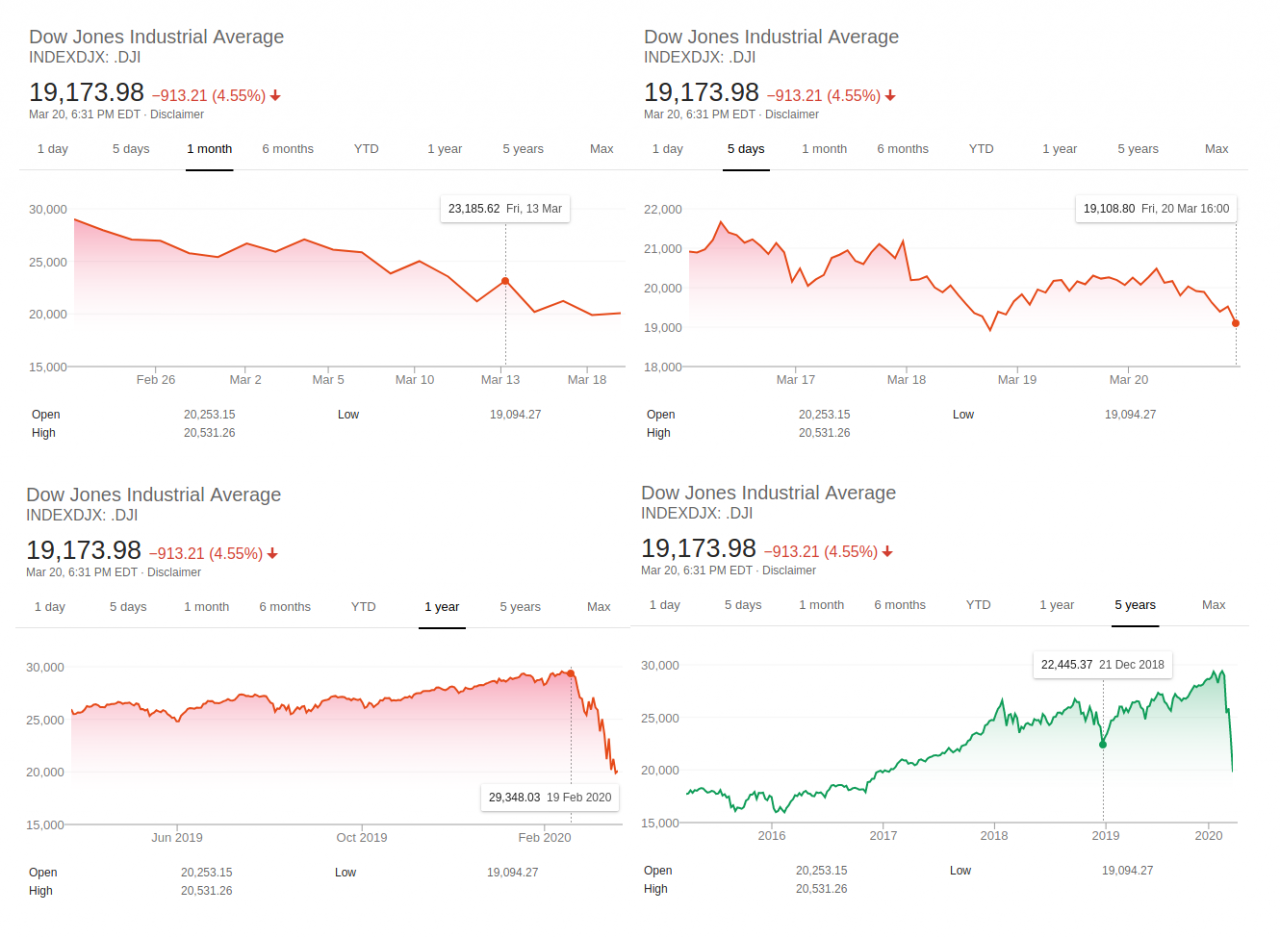
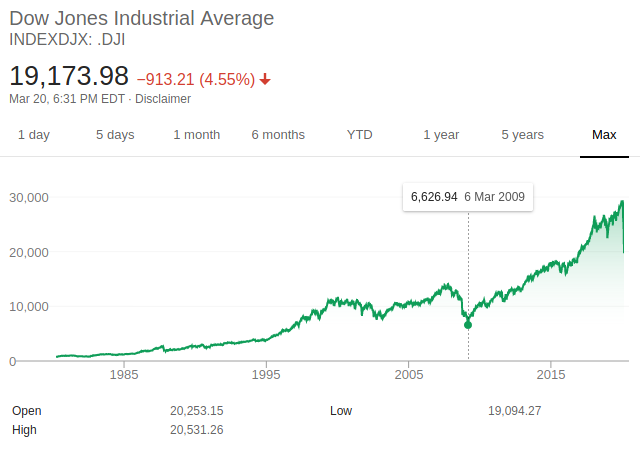
Monday, March 23 the markets went down 3%, but it looks like most of the stocks I have on my list went up. Seems like investors are buying in now at what they consider low prices for the stocks. Gold up less than 1%. Brent up to $28. Bitcoin up to $6630. It might be a good time to buy in, given the temporary nature of the event, but I don't think I'll really look into stocks for a bit, and I'm not sure confidence might go down again.
Our city extended its quarantine to Tuesday night when the national quarantine begins. Scheduled to April 13 so far (2 weeks).
Haven't really been keeping up on news with how things are progressing, since the city's been pretty quiet and I can actually work on things I care more about, which is something extremely rare. I'd like to read it, but I don't think I'll have time to write it, that being the sort of thing I usually do, but do because it's too noisy to work on anything that requires concentration.
An image of what the country's website for the Coronavirus looks like:
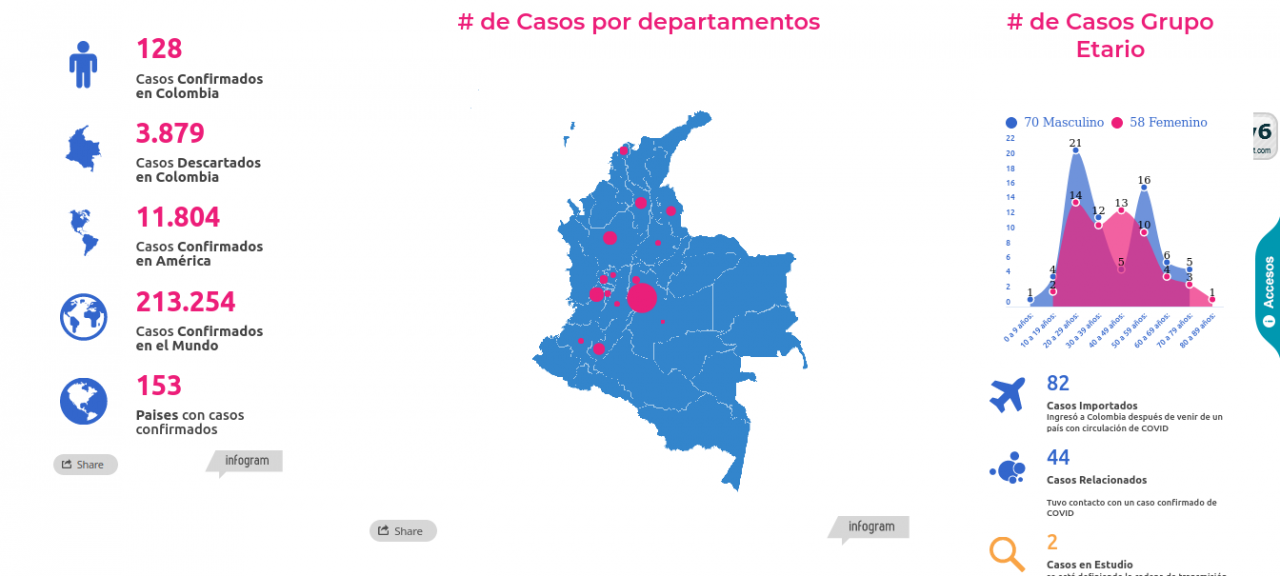
A stock that went down like the rest, but since March 16 has climbed pretty steadily back up is NFLX. Village Super Market has done well since March 12. Sprouts Farmers also, although is went down 6% today. Teladoc Health since the 17th. Ring Central since the 16th. Zoom since the 16th, dramatically. Everything else has either stayed down or has fluctuated. Pretty early on making any decisions based on even these few gainers though.
Tuesday, March 24 DOW up 11% (biggest gain since 1933 Depression). Basically all stocks up, including the ones that had gone down the most (cruise ships, airlines). Does this have to do with the President's comment yesterday that people would be ok to go back to work Monday? Analysts say its because the US stimulus bill is nearing (6t, 2t direct assistance and 4t in Federal Reserve lending power). Most commenters are not thinking there is a bottom yet, despite the day's gains.
I don't understand the position the US government is taking, unless it's strictly economic ie to just go through it and come out on the other side in a few months in a stronger position due to having less older people (which of course don't create goods and services, but cost money for a State), as well as the money they have saved transferred to new hands to spend or invest, plus the death tax the government takes from the transaction (if I remember correctly). Houses and properties would also change hands, which includes money to government also. They would also be in a strong position relative to other countries who care more about keeping their grandparents and will have tried to limit the virus spread. This may not be what they're thinking. I don't know what the US government is thinking here.
The streets were busy outside today. I think it was that the people didn't know that the quarantine was changed a couple days ago. It was originally to end today and there'd be today with no quarantine until tonight when the national quarantine begins. The state government changed this to extend to tonight the local quarantine when the state one kicks in. There were lots of people out today. Some shops opened (and then closed pretty soon). Then there were lines of people I think signing up for aid or something. No one was doing social distancing. Actually maybe I did see a few people doing it, in masks too. Most masks here are just cloth masks that look like hospital masks (they're blue), and I don't think have any type of filters.
In Wuhan, from lockdown to peak number of cases was 6 weeks, and hospitalizations increased after that for 4 more weeks.
There wasn't in the US national strategic stockpile was they ended up needing. Importing medical devices from other countries will be stopped at the border, even N-95 masks. Some talk of exercising discretion on that for a couple months (talk among commenters).
Some companies may be long-term beneficiaries besides Zoom, like Chipolte for delivery and other fast food. Lowe's and other home improvement retailers, considered part of the critical retail infrastructure of the country because they need to be kept open in order to keep society functioning. A lot of businesses continue like health care, telecom, utilities, many tech businesses. Restaurants can continue to deliver and have pick up.
Some people think the recession will be worse than 2008.
Wednesday March 25 and the DOW went up over 2%, the first time it's gone up two days in a row since it started falling. Most of the stocks I've been watching up, including cruise lines and things for the second day with big percentage gains. Gold stocks half up half down. Some of the stocks that had fared well during the past few weeks like semicons and software down a bit. Gold down a percent. Brent about the same.
Drug research is going through international trials, ie several countries at once. Remdesivir the Ebola drug, Chloroquine the Malaria drug, and a few others, in various combinations.
In Italy, new cases still but the percentages of new cases is going down. Many of the new deaths contracted Coronavirus before the lockdown.
Thursday March 26 the third day the markets went up, the DOW up over 6%, and futures went up also today after going down the last while. The DOW is up 21% in 3 days. Despite a joblessness report with between 3 - 4 million people this week, the highest ever by far. For the past decades, it's gone between 250k and 750k, often spiking to around 500k. The 2008 Recession was like that too, the worst week had 650k. Now there's a straight line straight up to 3.5m.
Analysts are calling it the liquidity rally then the rebalancing, as a stage 1. Stage 2 might be the economic buffer, the question is if the relief package is going to be enough.
Gold down over a percent. Brent still around $27. Bitcoin at $6800. Most stocks I'm watching up. Cruise lines went down 5 or 7 percent though. Gold stocks mix of up and down.
US government has indicted Venezuelan PM Maduro of narcoterrorism conspiracy, drug trafficking, and corruption. A Venezuelan official called the US's action a 'new form of coup d'etat based on miserable, vulgar and unfounded accusations.' The US government offered a cash reward of up to $15m info leading to the arrest and conviction of the Venezuelan leader and other high ranking officials it has accused of being what the US government calls 'The Cartel of the Suns' who the US government says is colluding with a dissident faction of the demobilized Colombian armed FARC group 'to flood the US with cocaine.' Maduro has been the target of US sanctions since 2013 and US efforts to push him from power. The US and some other countries recognize instead of Maduro the opposition leader as the 'legitimate president.' The US government also offers $10m for info leading to the arrest of Venezuela's chief justice of the supreme court.
Venezuela has the largest proven oil reserves in the world, approximately 300b barrels. The Orinoco Belt is estimated to contain 900-1400b barrels of heaby crude (400-600b technically recoverable). In 2010 Venezueal produced 3.1m barrels and exported 2.4m of them per day.
Reportedly, Maduro has recently been turning over control of oil production to foreign firms to maintain control. I don't know the details.
Apparently, people who want to go to South Africa to help out can't because paperwork is tough (government).
New York has built an emergency hospital in a conference center. A Mercy ship is on its way to LA I think, or NY, with around 1000 beds. LA expects to need 3000 - 30,000 beds. Florida has not shut down. The US has 300,000 available beds or a total of 900,000 in its hospitals (3 beds per 1000 people, compared with 12 and 13 for Korea and Japan, the most in the world per 1000).
Friday, March 27 and the markets basically went up until shortly before close and then people sold lower, which is actually what commenters were talking about yesterday, that there was some room to go up at least for part of the day. Basically all stocks went down a couple percent on my list. The cruise lines and other companies affected most, which had gone up during the week, went down a lot, like 10 or 20 percent again. All the gold stocks went down. Situation up stocks, like Zoom and Ringcentral, went up, at least a couple of them, which I think some of these had gone down during the week while other stocks went up. Gold went up a little. Brent still around $28. Bitcoin dropped around $300 to $6300. Some investors were going in yesterday and before into the market, others were noting how every drop like this that had a rebound was retested later to new lows except like one. I personally can't understand how anyone would want to tie money up in stocks at this point knowing they could go down and stay down for quite a while. If I had an algo that would test pressures I would use it though in the fluctuating market.
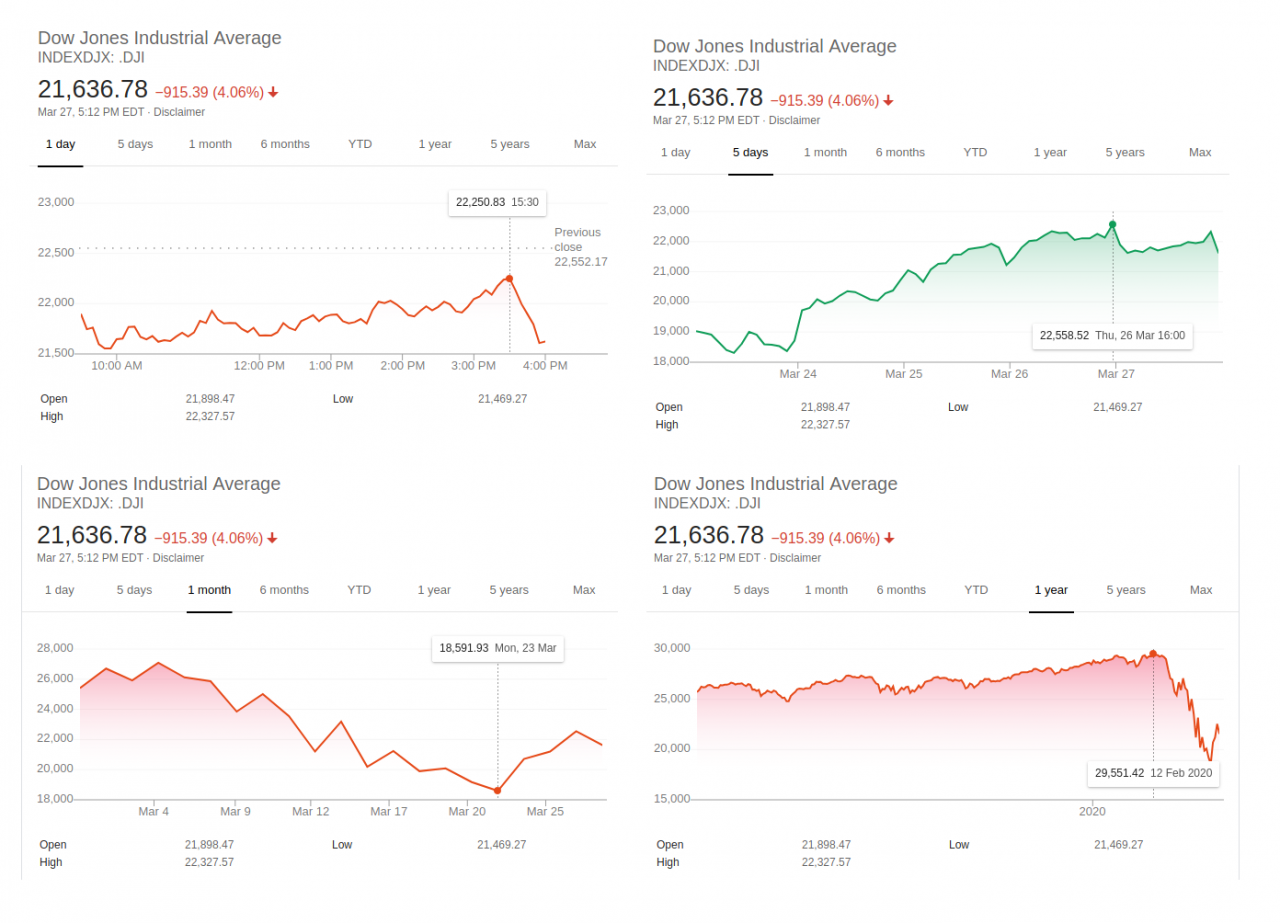
Trump signed the $2b stimulus bill. The total value of the package is I think $7b, half in loans. There might be an issue coming up in popular discontent with the issue of debt growth in companies and buying back stock. Some say policy makers encouraged this in their laws as a way to drive up market prices. Airlines, the industry, not a specific company, for example, bought back stock $45b over the last decade and now the industry wants a $50b bailout program. Programs might 'have to' expand to bail out hotels, car rental companies, energy companies and others, citizens might be unhappy with Washington.
Another issue might be mortgage REITs. Some have lost 80% of their value in the last month. These particular funding companies invest not in mortgage properties but in mortgage bonds, and they buy these bonds on margin (the borrow to buy them). When the value of them starts to go down, margin calls happen. They have to sell, and when they have to sell, other REITS might have to sell also. Some similar mortgage REITs have done better, the ones that invest in government-backed mortgage bonds. It puts pressure also on banks and individual investors, many of which are looking towards retirement income. I don't really understand this issue. The federal reserve is pumping money daily into residential agency mortgage backed bonds and that is helping some of the mortage REIT companies. Debt servicers face a problem in that they still have to pay their investors and MBS, while the big US ones have all announced forbearance programs so borrowers can delay monthly payments. They've asked the fed for some kind of liquidity line to pay investors.
Ventilators are not abundant. Some companies are ramping up production, Ventech from 100 to 1000 per month, and companies are going to be allowed to modify production models without the same checking regulations. Automakers and vacuum makers are repurposing factories in the UK and US. States are competing with other states, it's been reported, and dealing with price-gouging. Counties, cities and hospitals are doing these things on their own in the US, rather than the federal government organizing things. Auto-makers have their own conventional shops where they make their own tooling and prototype parts, manned by highly skilled workers who can read drawings, read computer print outs, and make things.
There are over 100 small parts that go into a ventilator. These parts are also a limited global supply. And some are intellectual property.
A ventilator is a complicated machine, which has a complicated sensing process to tell how much pressure and how much volume to put into the lungs of a conscious or unconscious patient to give enough oxygen but not to damage lungs by expanding them too much. The process of producing one is usually tightly regulated. They cost $25,000 for a basic model to $50,000 for an intensive care unit ones, which hospitals particularly smaller hospitals can't afford them without becoming bankrupt, and what will they do with them afterwards. In the hospital, ventilators generally require a trained medical team, a respiratory therapist, a nurse and some kind of doctor that's usually a pulmonologist. I don't know if really these people are actually necessary to provide ventilation though. People are looking at how to gerry rig them to use for more than one person, or using people to manually ventilate patients, such as was done in the 1952 Polio crisis by medical student volunteers and is done in poorer countries.
NY said they need 18,000 ventilators. The ventilation treatments in the UK are for 2 weeks.
People are developing and producing alternatives to the ventilators we have in our hospitals though. There's one some Indians developed that uses and Android phone and a small machine which sells for I think around $600. Another one was put together, also small, but uses its own circuitboard and not a phone. Mercedes F1 is also reportedly going to mass produce CPAP breathing units, which assist a person through negative pressure,.
The kits being imported from South Korea to LA cost $60, and LA county is going to buy 100,000 per week, cheaper than the WHO $150 ones, and the next type might be under $10. It's estimated a few billion will be needed.
Some authorities have been saying tests aren't needed because it's in the community, but this doesn't make sense to me because since most people don't know they have it, only with testing would you know who should be isolated for 2 weeks and who you can still spend time with. If you get tested, you can go and see your family and know you're not going to infect them.
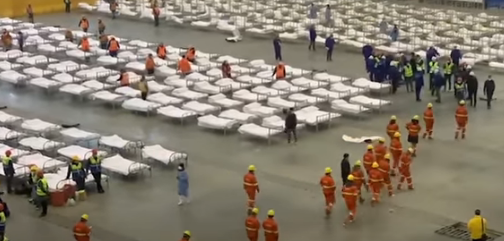
Wuhan temporary hospital
There might be a theraputic by the summer. Convalescent plasma (from people who have recovered and put into people who are sick) is having a theraputic benefit, which comports with what we know of convalescent plasma in this setting, it was used in H1N1 and Spanish Flu with theraputic benefits. This means monoclone antibodies can also work in this setting, they think, like Regeneron's project, and there might be hundreds of thousands of doses made by them in the summer.
Around 3b people are on lock down, including all of India's 1.3b.
An island off the coast of an Australian city has reportedly been converted into a sort of isolation island.
In Korea, where the situation has been handled as well as any place except China (where stricter measures are complied with the by population perhaps), 30% of new cases are people in their 20s. This may be because people of that age worry less about their own mortality and continue to go out to Gangnam, restaurants, internet cafes, and other places where they're packed in tight. Another 20% of new cases come in from international flights. (My source is from the 24th though).
The reason the WHO might be advising normal people not wear masks (although reportedly they advise people in Asia to wear them due to cultural differences) is that there aren't enough masks and they don't want to be out of them when health care providers still need them. Europe and the US were unprepared in the way Korea, and they mark it down to perhaps their experience with the half dozen new infectious diseases over the past 20 years including MERS in which only Korea was affected really outside of the Middle East, and knowing they have to contain viruses, have to wash hands and wear masks.
In Korea, the test costs $140 and takes 6 hours, but because there are so many done, 13,000 a day, people are held in an isolated room until the next day to get results. People who want to pay for a test (who don't have symptoms) are reimbursed the cost if they test positive.
Monday, March 30 the market went up 3%. Bitcoin up. Brent down to $23. Gold just down a bit. Economists think there's a bottom now, but maybe not THE bottom. In 2001, 2002 and 2008 there were two rallies of 20% for each one that failed. They think what is missing is TIME, because we have worse economic data to see. Markets are looking right past that. Is that amazing? Energy stocks and cruise lines went down, about 10% for cruise lines. I'll probably buy into them. Later I bought Norwegian and Carnival for the open and would have bought Caribbean but something funny happened with a previous trade. I tried calling my broker, TD waterhouse, and perhaps it was just something with the platform, and the platform generally sucks and has for a long time. When I tried calling them I waited an hour and 20 minutes before I gave up. Staffing, the message said. The stocks went up on opening, and went up like 10 and 20 percent and I thought that was perhaps too high so sold them. They went down to up around 2 and 3 percent for the day at close, although I'm not sure about those numbers because it looked like they might have closed up a bit more than that. If they'd gone down all day I would've I think held them and been long on them for the next couple years. I'd buy into them again if there are new lows.
New York (a charity there is funding I take it) a field hospital in Central Park. The charity has been operating a similar hospital outside of Milan for over a week.
Apparently, someone stole a van Gogh from the Louvre or some museum.
Tuesday March 31 the markets were up a percent or two this morning but closed 2% down. The VIX went down although still in the 50s which is relatively very high. Brent the same. Gold the same. Equities behaved seemingly normally though, and so did bonds and the credit market. Analyists are wondering whether there will be a re-test in the coming month that will bring new lows. Some are weighing in for yes or no. No one is certain about anything. Some cmmenters think that some businesses will do well because they will emerge at some point in a better market position, while companies with less strong books will not make it, so better to not invest in the indexes but instead specifically in businesses that won't go bankrupt.
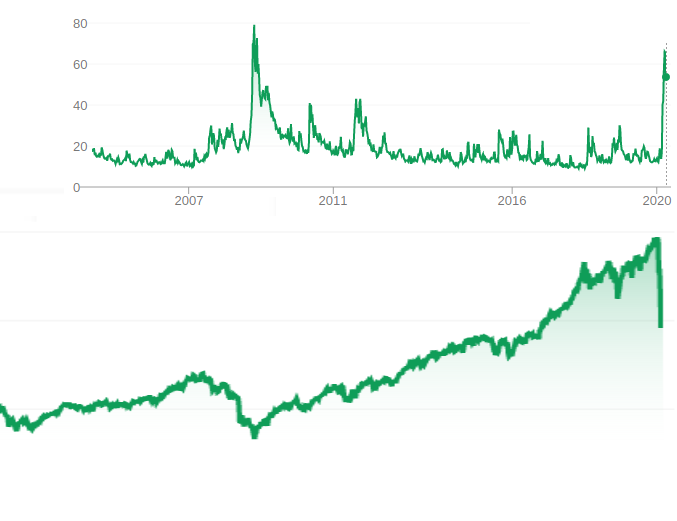
VIX and DOW
There were a lot more people out and about downtown today from the morning. However some people, including Venezuelans, were detained for a bit for being out, including someone I half-know, but were let go instead of having to stay 12 hours in the truck.
New cases in America rising partly because they're testing a lot more. Italy is 23 days into lockdown and new infections are down but still at under 8%, perhaps because there was already so much community spread before lockdown started. Countries that had less community spread before lockdown might have a quicker reaction.
Reportedly, there is internal migrant crowding in India as people try to return to their home villages.
Recently people were allowed to leave Wuhan but it seems there was a barricade not allowing them over a bridge by a neighbouring location. I don't know if this is true. News about China is unreliable on either side. The government censors any official news, while anti-China entities push fake China news to make it look bad, such as using videos from other events and relabelling them to make them look like things happening with current events. So there are no reliable news sources on China period. If someone wanted to be one, they would be either hired and converted by the government or silenced.
People expect a baby boom in December.
A report has it that in US care homes, the fatality rate is 34%.
A question coming up is whether the West can or should use things like the tracking and monitoring apps China and Korea used and use with success against the pandemic. For Westerners this is anathema, but I think it's not the measure itself (well, in part) but also they rightly don't trust the government with that information, nor any organization with it. It would be different if privacy and security was reliably (totally reliably and tested) baked into the system. Currently there aren't any countries where the people trust or can trust their country's government, maybe that is something that will happen in the future. We're improving on some things, like the current recession would be worse if nations like the US and I think some European nations (Canada already had good banking regulations from what I've heard) hadn't improved their banking systems since the 2008 09 recession. Due to that, the banks have strict regulations for everything, protocols for if this happens you do this, and the banks are in really good shape with good books. So are a lot of big companies. We can avoid or mitigate many problems in the current situation because we have strong banks in many countries. Due to this, the current issue is a liquidity issue, not a real credit issue. People are not going to make their credit commitments like mortgages, but it's because the whole country is shut down, and what they need is a time out of 90 days or so, where the mortgage they don't pay there will be tacked on the end of their payment schedule instead. After all, those people are people the credit institutions did business with, wanted to do business with. The main people with something at risk in this recession are owners, small medium and large.
Wednesday April 1 DOW went up a bit until around 11 but closed down 4%. Most stocks down. Affected companies were the most down. Gold the same. Brent the same at $26. Bitcoin at $6600.
Belgium you can go out multiple times per day as long as you are 'on the move.'
Australia masks are mandatory for shopping.
Thailand seems to have a new finger-prick test. A small piece like a pregnancy test, where you put a drop of blood on one part, and you see one line if you don't have the virus, two if you do have the virus. A faint second line if your body is already producing antibodies.
Commenters say the public is more optimistic than the timeline that is likely. So far people apparently think there can be a timeline, and its not too far away, and that it won't be too painful, too costly, to get to. Some are thinking about it as a repositioning opportunity, where even though your stocks might be down, so are other stocks, and you can sell ones that have no or insignificant cash reserves, that is very negative in cash flow, if it has a lot of debt. The bailouts that will come may come and also underline the capital structure of a company, and most of the bailouts might come with conditions. A diversified portfolio of value. Resistance zones, bear market rallies. Bear markets produce enticing rallies. In the Great Depression 86% of value was lost over 33 months but there were 8 rallies in the S&P that averaged 24% and these kept bringing investors back in, thinking it was over when the drops were 33% on average. Stocks are still 30% over valuation to the average. Not even to the lows. To get to the average market cap to GDP ratio the stock market has to go down 30%, and if GDP is going to be revised 10% or 20% lower the market needs to go down more to meet it, but because interest rates are lower so the multiple should bottom out at a higher level, but that's complicated by the fact low interest rates are hurting certain industries like banking so maybe it should be even worse not better, like it is in Europe with their negative interest rates. It might go down 50% to be oversold but that would take time.
The US treasury secretary is talking about investing in infrastructure.
Applications for new mortgages fell 20% last week compared to last year. Mortgage interest rates are at lows, so people are taking advantage and buying properties online.
Thursday April 2 the US unemployment claims doubled to 7m. Some expect 60m jobless before the story is told. The DOW went up 2% after being down a couple percent early in the morning. Stocks half up half down. Gold up 2%. Brent went up to $30. Bitcoin up to $6800.
OIl has to be $23 to keep current drills open. $49 - 55 to entice profits. One company filed for bankruptcy this week. Expected to be a number of dominoes falling over the next couple of years due to balance sheets. According to some analysts low oil prices is not good because economic growth drives commodity prices, not the other way around. A low price in oil or copper or aluminum means there is some economic hardship in the future.
Friday April 3 It seems Sweden is taking a different approach than the rest of Europe to Coronavirus, where schools and shopping centers are open etc.
Trump has invoked the Defence Production Act and requested 3M, a company that makes masks and respirators and things, based in Minnesota but producing some masks in China and some respirators in the US, to turn up imports of masks, which 3M did, but also to divert respirators for Canada and Latin America. 3M published a note on this saying doing such would represent humanitarian issues because they are a critical supplier of respirators to those countries, and also that those countries and maybe others would retaliate by making less respirators available to the US. Trump tweeted a threatening tweet about 3M in response.
Aircraft account for 7% of global greenhouse gas emissions, but companies like Lufthansa have cut about 90% of flights. Big ones are bleeding $60m per day, smaller ones $10m. An industry very cyclical and macro-dependent.
Hotels are also down 90%.
The leader of the White House task force on Coronavirus has been receiving death threats and is beefing up his security.
Some countries are organizing special flights to return citizens to their home countries.
After the virus, the previous trend to densification in space may reverse, some realty experts say, towards more space, two shifts, working from home more like they are now, maybe not wanting to live in the city where currently it has been the most popular, especially the 'capital of the world' NY and LA, everyone has moved towards the cities for decades, and people and companies might still be thinking about the next virus and want to live and operate with more space. More space in their apartments, more space outdoors, air quality, the type of construction materials used.
Markets looking fairly normal in terms of behavior. Brent went up 17% to $35. Gold about the same.
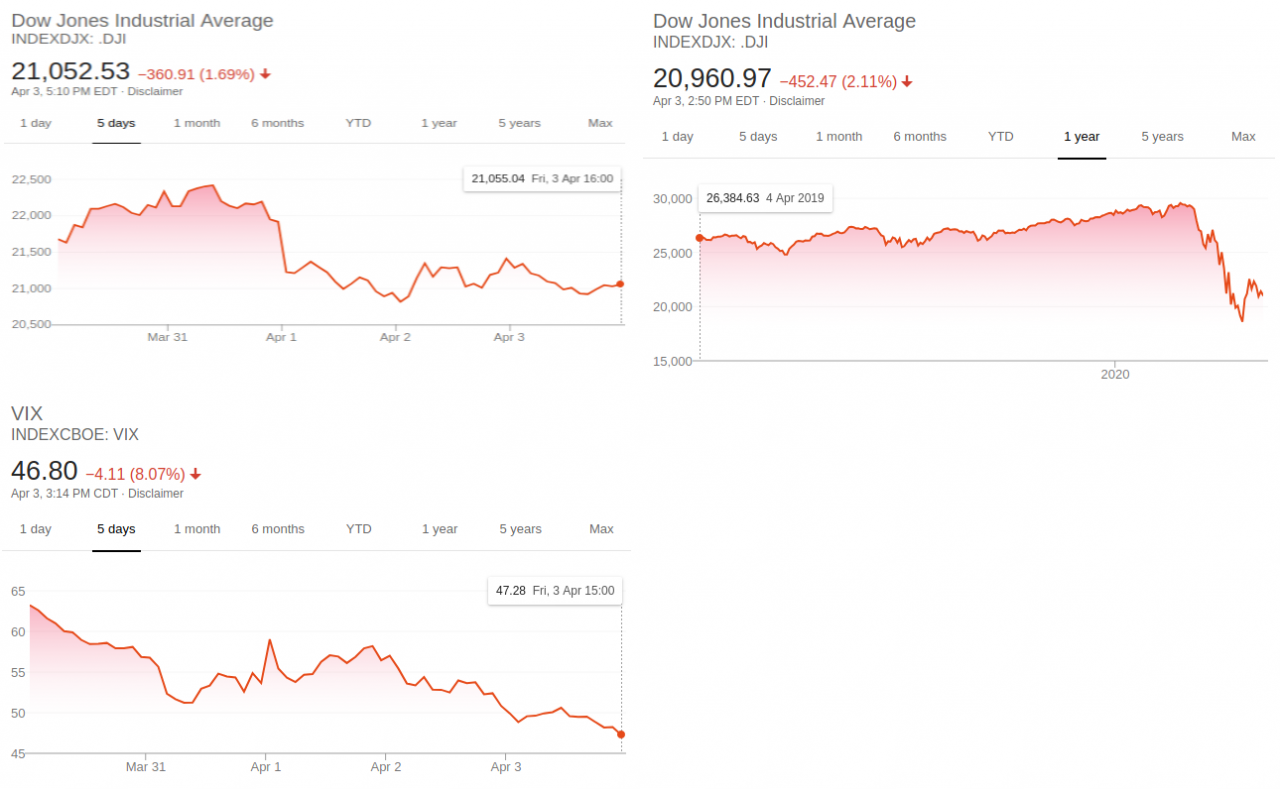
Morgan Stanley is now thinking there won't be a strong rebound in Q3, and activity won't return to pre-Coronavirus levels until the end of 2021.
Some commentators are thinking of Amazon and Microsoft as infrastructure plays. They're how we're getting by right now.
They say it will be a bad year for earnings, down 30%, and companies can basically throw all their bad stuff into this year, making a real decline in earnings with something to blame it on, and then in 2021 go with a clean slate towards a typically strong earnings recovery coming out of a recession.
Shortsellers are looking at companies that because they don't have solid business models they won't come out of this looking very good, that lost money in 2019 and are going to lose more money in 2020 and might not make money in 2021, but are still priced at a premium based on 2021.
One of the business models that might be exposed in 2020 are restaurant brands like Wendy's, Dunkin' and QSR, which are essentially franchisers to business owners who are highly leveraged with some Chapter 11s in the months before March, and who also lease real estate to their franchises, and who also bought back a lot of stock at highs, and so are triple leveraged you might say. One of the dark sides of the buyback boom. Another is the gig economy, which might have a very big labor pool coming out of this recession, where their unemployment as independent contractors is payed by taxes rather than companies that would have paid into benefits pools. Labor relations.
In bull markets and recessions fraudulent operators are discovered, and the second wave after the initial shock of people selling off stocks is realizing some companies that seemed great weren't actually performing magic. In a long bull market people's sense of disbelief is reduced. Also cheap capital is available. Chinese companies too.
Relations might get worse between the US and China. Corporate supply chains and reliance on imported products that are essential to well being and national security.
No clear path with oil situation, some think it's worse than the 70s crisis. Some are better positioned to survive with a dividend for 12-18 months, like Total, Equinor and Galt, compared to ones that might not like Shell, Rexhall and MV.
Saturday the US and Canada are now advising wearing non-medical masks. The chief US guy on this is now using the word aerosolization, that people can spread the virus by talking, and it can remain in the air a while, and that people can spread it asymptomatically.
The UK released some prisoners early.
Some tests are giving false negatives because they're not very accurate, so doctors are advised to diagnose by clinical diagnosis instead in the UK.
Alternative news seems to be hard questioning their support for the WHO and other global organizations, which ones they can be part of, which they can influence to change, and how much they remake their sovereignty, and how they've allowed 30 years of globalization and identity politics to take away from the country's national interest.
With the WHO, which every nation pays into, which has been criticizing Western countries and praising China, saying there's no interpersonal transmission going on in China, is being questioned because of the influence of China on it, and is being called a joke.
An epidemiologist for the WHO has recently been singing praises of China in news broadcasts was recently asked about whether the WHO should consider Taiwan's membership and he stalled for 10 seconds, then said he didn't hear it, and when the reporter said she would ask it again, he said 'No that's OK let's move to another one then.' She said she was actually curious about Taiwan, about Taiwan's case and the line was dropped. They called back and asked how Taiwan had done on controlling Coronavirus, and he said ' Well we've already talked about China.' A Japanese politician also recently made statements about this, and Trump also signed the second US contract with Taipei that uses the word 'Taiwan.'
The UN is also considered by the same people corrupted. A lot of these criticisms point in large part to China specifically.
According to some analysts, Russia wants to damage US shale, even if not bankrupting it, making it less globally significant in terms of supply-demand imbalances. Saudi wants to hurt Russia for agreeing to the 2016 OPEC agreement, where Russia hasn't cut back on production. It has only cut production flat. Russia also hasn't followed through with planned investments in SA, reportedly.
I'm really curious what the US can do to retaliate against Russia and SA.
Sunday the psychology of this state of society, which may last 3 months, and how are people going to get by? it makes a person really kind of angry. One of the things available for anger is the inefficient responses of the government, although it depends as much on the citizenry who are no more responsible. If everyone was serious for 3 weeks, society could return to normal. We're in our third week of lockdown, scheduled to end in about a week from now, but it can't and most likely won't. America and Russia have already extended theirs till the beginning of May. A three month lockdown puts us in June. People may get angry and start blaming people for this misfortune. The obvious target is China, but fairly no country I've seen has been any more proactive and responsible, nor set about coordinating sustenance and caretaking measures for the period of lockdown. People on the streets cursing China and other countries, while not wearing masks and sitting around with other people. I think a lot of people, having experienced a few weeks of lockdown and presuming another 3 months, might be weighing the odds of simply behaving as normal and getting the virus, although we can't, because it's too risky for old people and even for people of all ages.
In Colombia, there are hundreds of thousands of Venezuelans who decided to come because it seems better than in Venezuela, where life is dire for many. It's more than Colombians want to accept, and they've been raising the same issues as always with mass migration, disturbances in labor, wages, etc. The borders are closed now and there are no buses to Venezuela. What are these people to do? If the government doesn't take care of them, what will happen to them? From what a friend sent me (although it's unconfirmed and could be false news) the protections for not evicting people when they can't pay their rent doesn't apply to non-Colombians, and Venezuelans are living on the streets. Again I'll stress I don't know how real this is, and you have to consider the nature of social media news and the people who it interests. Those who have something to offer might find themselves a temporary arrangement. Those who have connections, family, friends, might live with someone else. I had a friend who apparently was going to do this yesterday, and live in a barrio outside of the city a ways. Those who have the least to offer are in the direst straits. Some were asking for help regularly even before the current situation. I'm currently helping four or five people I know to survive. But the prospect of three months. When you consider there is no way to get relief or let off steam or progress in any activities or projects in the near future, but only this situation, it becomes more sort of aggravating.
The streets still seem relatively peaceful. I don't think people are considering three months, and maybe the situation hasn't deepened in how dire it is yet. It's been only a couple weeks and they think another week or so. There is police coverage on most of the streets.
You can't really even make plans, since no one knows when there will be a vaccine or drug cure, although most likely a few months before a drug and a year before a vaccine. Everyone's just stuck in place.
The biggest question economists have for the current events is credit for corporations. Bonds are buying debt at whatever value you think it's worth, based on your estimation of the company that wants to borrow, and it's not indexed like stocks with NASDAQ. Over the years since 2008, a huge percentage of new debt have been by Tripple B companies, just on the edge of being below investment grade. 44% of the $10t market is Tripple B, a bigger chunk than the entire market in 2008. If they get downgraded because of the current situation and their prospects, a situation called 'fallen angels,' they'll automatically be removed from a bunch of investment grade bond ETFs because they'll no longer be investment grade. To get credit these companies will be facing very high rates ie having to give high yield to make lending appealing. Another aspect is that big companies that really didn't need to borrow, like Apple which 2008 started outstanding debt and now has over $100m, borrowed because they could do so at low rates, and they bought back their stock to raise it's price. Now, they may need government money, although probably a loan not a grant, to continue. So there may be a large spike in defaults, and this corporate bond market may do to the global economy what the mortgage market did to it in 2008. Also lots of companies have been borrowing when they really couldn't afford based on their fundamentals to because the credit cycle had been eased for the past 12 years. Lax credit standards. It could be bigger than 2008. The central bank has been purposefully stimulating the economy by buying safe debt, so credit institutions would focus on other companies, which they have done, and the companies could take advantage of this by getting credit for less because investors were looking for yield ANYWHERE. Investors are doing too much risk for the yield they're getting, which causes a problem when something happens like is now. Like the oil market in the US, although there will be pain coming, some think its good the credit system gets shaken out and take on a form where investors can get appropriate yield for their investments in bonds.
Right now both the bond and stock market are going down, and before that they'd both been going up, which tells some analysts something is wrong, because theoretically and historically when one goes up the other goes down. Now the only market gaining value is the treasury market.
Price discovery is impaired globally because the US dollar value is uncertain as the global currency. Everyone wants not only liquidity but dollars. The Fed has made it possible to exchange your best assets, treasuries, for cash.
There's a 'dollar crisis' where no one knows what will happen with it. Everyone wants US dollars.
People are talking about the problem in the global supply chain where one country produces everything for every country, and everyone is exposed to that link in the chain.
With all the money out there, maybe something will happen where now portfolio investors chase yield globally, maybe governments will limit that and instead issue sovereign debt you can buy and we spend it on hospitals, dams, whatever. Financing stuff locally. Fracturing the global finance world.
Continued in Part III: http://tttthis.com/edit/blog/talk-of-recession-and-coronavirus-2020-part-iii
Related material:
https://news.3m.com/blog/3m-stories/3m-response-defense-production-act-order?mod=article_inline
https://rstudio-pubs-static.s3.amazonaws.com/108399_66e9af15e17d49fbbdc250527611a580.html


