Old English
https://www.st-andrews.ac.uk/~cr30/vocabulary/
Greek
https://en.wiktionary.org/wiki/Appendix:Ancient_Greek_words_with_English_derivatives
Old English
https://www.st-andrews.ac.uk/~cr30/vocabulary/
Greek
https://en.wiktionary.org/wiki/Appendix:Ancient_Greek_words_with_English_derivatives
Casting Metal in Molds
microwave melting -- there are inexpensive microwave kilns that will melt small amounts ("jewelry" quantities) of many metals.
SAND
Aquarium sand from a pet store is very find (or play sand but you have to sift it)
Kitty Litter (clay)
add WATER
GLASS
CNC mold from 3d files
INVESTMENT CASTING
Glaze
SILVER
3D PRITING NOTES
if the machine is too hot, the plastic melts flat. If it's too cold, it doesn't melt and so doesn't stick.
Doing levelling and pre-heating makes a difference
ISSUES
Thin layer of PLA stuck to build plate and can't remove. Heat hot (max is 100 but probably 70 or 80 is enough and it will peel off with a plastic scraping tool)
Ender 3 3d Printer: Assembly and Set Up
Ender 3 (not pro). Came with the flex bed.
Full tutorial: https://www.youtube.com/watch?v=dQ0q9zLygTY
Assembly takes about 1.5 hours, then setup another 20 minutes
Assemble with directions. It comes with 3 metal (things) and you just use one. The others are spares. The little blue parts do nothing, I think.
Make sure the 2 wires for X and E are in the right spots (you'll get an error message when you try to Auto Home that says ‘Homing Failed: Printer Halted Please Reset’, so you just switch them and try again to Auto Home).
The USB slot is not on the screen part but on the computer part.
Check voltage before plugging in.
Clip the filament (otherwise it won't go in) at a 45 degree angle. Feed it in from the outside using the lever and pushing. It goes right through that unit into the tube (which you connect and it should just basically feel locked in place)
SETUP
Auto Home to see if all the pulleys are working.
Level the bed: In the screen go to Prepare > Disable Steppers, so now you can move the bed around manually. move the nozzle to each corner and use the knobs underneath to go almost touching. Each corner. Then take a piece of paper and do the same, so you just get a bit of resistance sliding the paper. Then Auto Home again, and then do the paper thing again (it might have moved quite a bit so don't be surprised). Now you can print.
Setup: https://www.youtube.com/watch?v=VIa-kaPkseg
When taking the bed out, lift it, because dragging the surface can scratch the glass (by lift it, I mean drag it upwards, against the black parts)
When tightening the screws on the build plate (with an allen key), do the front one first then the side one.
Leveler not included, so use your own, and level the base of the device
When filling the tray with resin, don't go to max level unless you have to (messier), and don't worry about bubbles.
That weird black plastic part is an attachment for drip drying (smaller) prints
Used resin goes back in the bottle (use a filter just to keep out plastic parts)
To clean a print, dip it in Isopropyl Alcohol from the drug store, a few minutes (some say longer the better but longer also dulls prints), then dip it in water.
To cure a print, nothign more than an hour. Just set it outside in the sun if you don't have the special washing/curing machine).
Some resins come with special instructions (like over for 20 minutes) but these special instructions don't apply to most resins. All you need for regular resins is to clean resin in alcohol and cure in sunlight.
RESINS
You can leave the resin in the tray of the printer for months, but it's a good idea to cover it so no UV gets in. Stir before using again.
(water washable versus) https://www.youtube.com/watch?v=ht4tbCiFxeM
The water washable ones are not any better in terms of breathing fumes. They can be ‘stinkier' even. If a resin bothers you, change to another, as they vary from one to another. However, resin is not worse than a lot of other things people have in the house like bleach and new furniture. Pay attention and see if you get a headache or anything. The main thing people look for seems to be skin or lung irritation, and it seems it can build up over exposure time.
The way the UV curing process works it that the light is absorbed as a single photon that breaks a bond with a specific energy and that means the light has a minimum energy in order to work. The energy translates into a specific wavelength and you can look up the critical wavelength on the manufacturer’s website. This same value is usually published in the user manual that comes with the resin. What brings this into question is light sources that have many wavelengths like sunlight or a high intensity bulb. I have observed this in the UV curing resin used for bonding glass. It has a critical wavelength of 365 nm which is not visible and it doesn’t show up in “black light” bulbs at all. We can get resin to cure in sunlight but it is pretty slow and the light source we used to use is 750 Watts and heats up the building but it will give you a nice tan. The replacement we found is an led with a peak emission at 365 nm and it uses about 20 watts. So more energy doesn’t make it cure faster only the right wavelength will do and if you have that you only need a small amount of energy.
Typically eg the lamps used for auto lamps could be 350 watt per inch and may be 110 inch long. So consumed about 40 Kw per lamp
The lamps may have a spectrum with pure Hg or may have additives. Which modify the SPD. Some curing lamps cure the paints of cars, employing about 85 inch long lamp and consuming 400 watt per inch.
Curing in sunlight (not cloudy) for 2 or 3 hours. You can put it in a plastic bag or container filled with water so the water diffuses the light and lend a more even cure. Oxygen in the air can cause the resin to dry out, so water will help there too.
CLEANING
RESINS
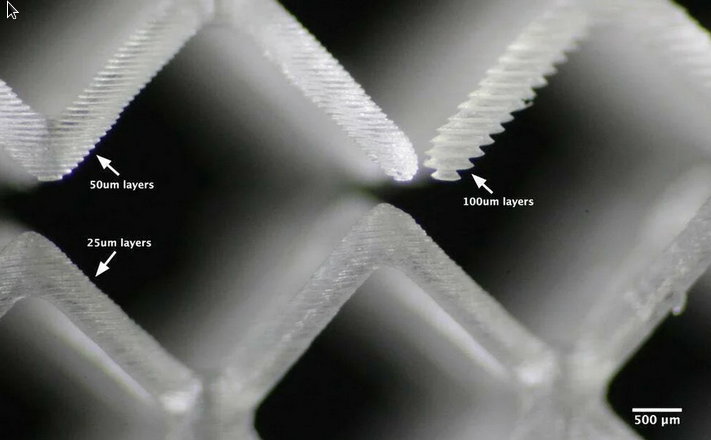
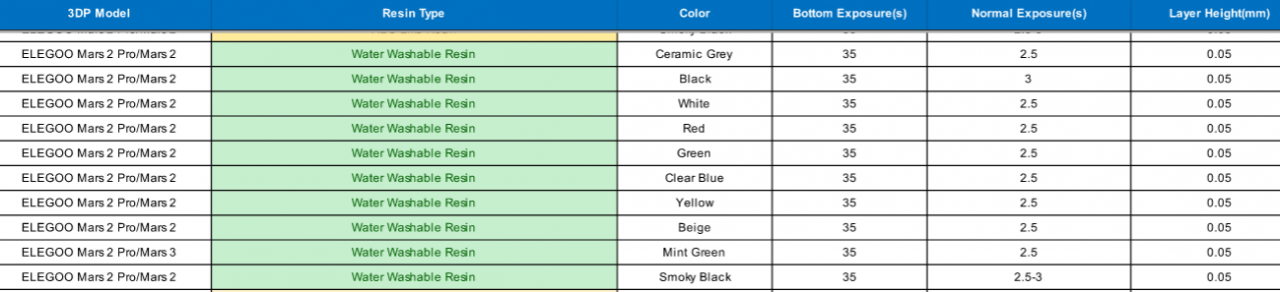
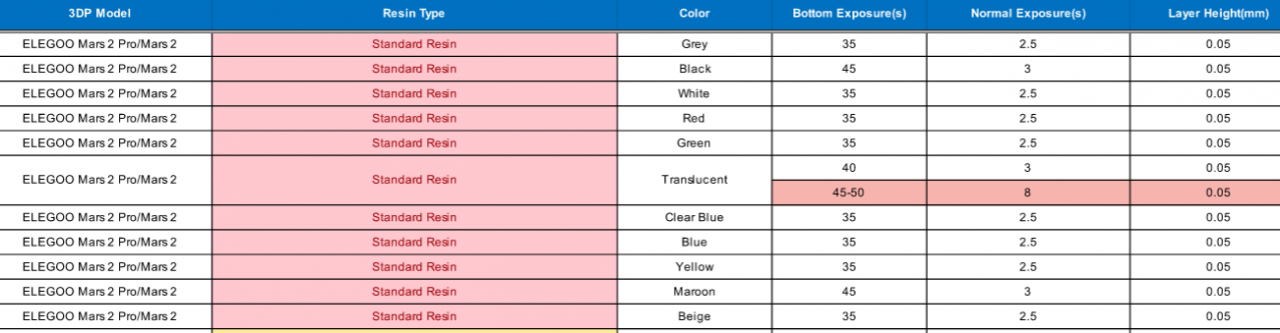
Prusa Slicer settings for Mars2 pro

ANODIZING ALUMINUM


